Introduction
The macadamia nuts benefits worth knowing come with a price tag measured in calories, so this guide starts there. A macadamia is the creamiest nut on the Indian shelf, rich and buttery in a way no other nut quite manages, and it carries healthy fats that most nuts cannot match. It also carries 718 kcal per 100 g, the highest energy of the common nuts, with the lowest protein and the lowest fibre of the same group. That is the deal in one line. A small handful gives you the good fats and the flavour, and a second handful gives you a meal worth of calories without feeling like one. This guide covers the ten reasons the nut earns its place, the palmitoleic acid story that sets it apart, the honest limits of the health claims, and five everyday Indian ways to eat it.
In this article
- The short answer
- What macadamia nuts actually are
- Macadamia nuts in numbers
- 10 benefits worth knowing
- The healthy fat story, honestly
- Raw, roasted and salted, whole and chopped
- Five everyday ways to use it
- Buying and storing macadamia nuts
- 5 expert tips
- Common mistakes to avoid
- Frequently asked questions
- Conclusion
The Short Answer
The macadamia nuts benefits that matter most are the healthy fats, the minerals and the flavour, in a nut that asks for a small portion. Raw macadamia nuts give 718 kcal, 7.91 g of protein, 75.77 g of fat and 8.6 g of fibre per 100 g, and a one ounce serving of 28 g, about 10 to 12 kernels, gives 204 kcal, 2.2 g of protein and 2.4 g of fibre. The fat is mostly monounsaturated, 58.88 g per 100 g, including 13.0 g of palmitoleic acid, unusually high for a nut. The portion is a small handful, about 10 to 12 kernels a day.
What Macadamia Nuts Actually Are
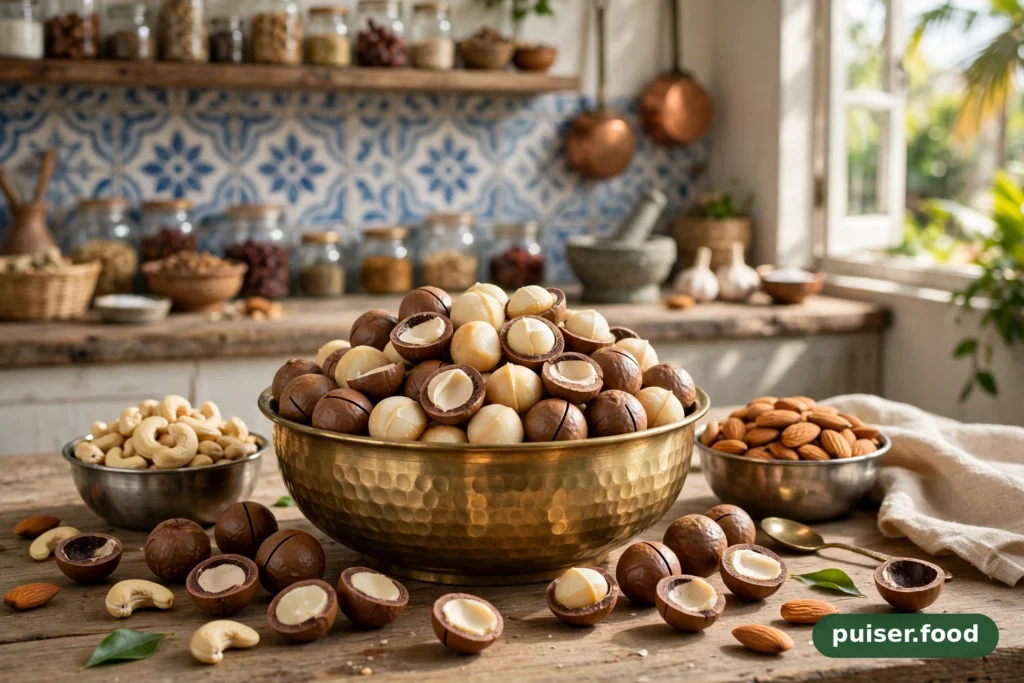
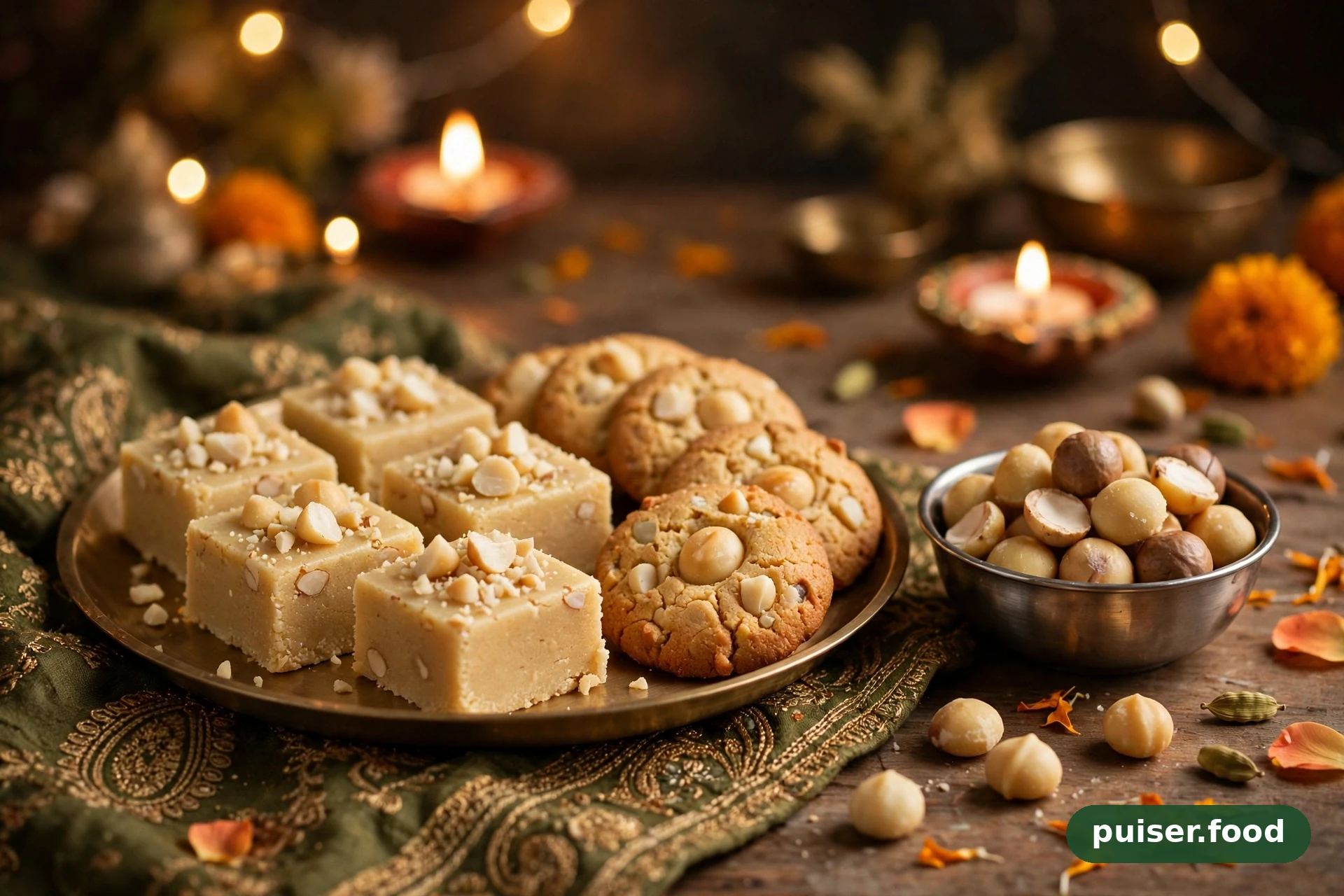
A macadamia is the round, creamy kernel of a tree that grows in Australia, where it is native, and in Hawaii, where it became a plantation crop. The kernel sits inside a hard brown shell, and the shelled nut is pale cream, smooth and almost buttery to bite. It tastes mild and rich, with a sweetness behind the fat, and it turns up in Indian kitchens in mithai, in cookies and in the gifting boxes that travel at Diwali and at weddings.
The macadamia nuts benefits start with the fat, because the nut is three quarters fat by weight, and most of that fat is monounsaturated. The fat is what makes the kernel creamy, and it is what makes the nut feel indulgent even in a small serving. Ten to 12 kernels make a serving, and that serving carries the flavour of the nut without the weight of a meal.
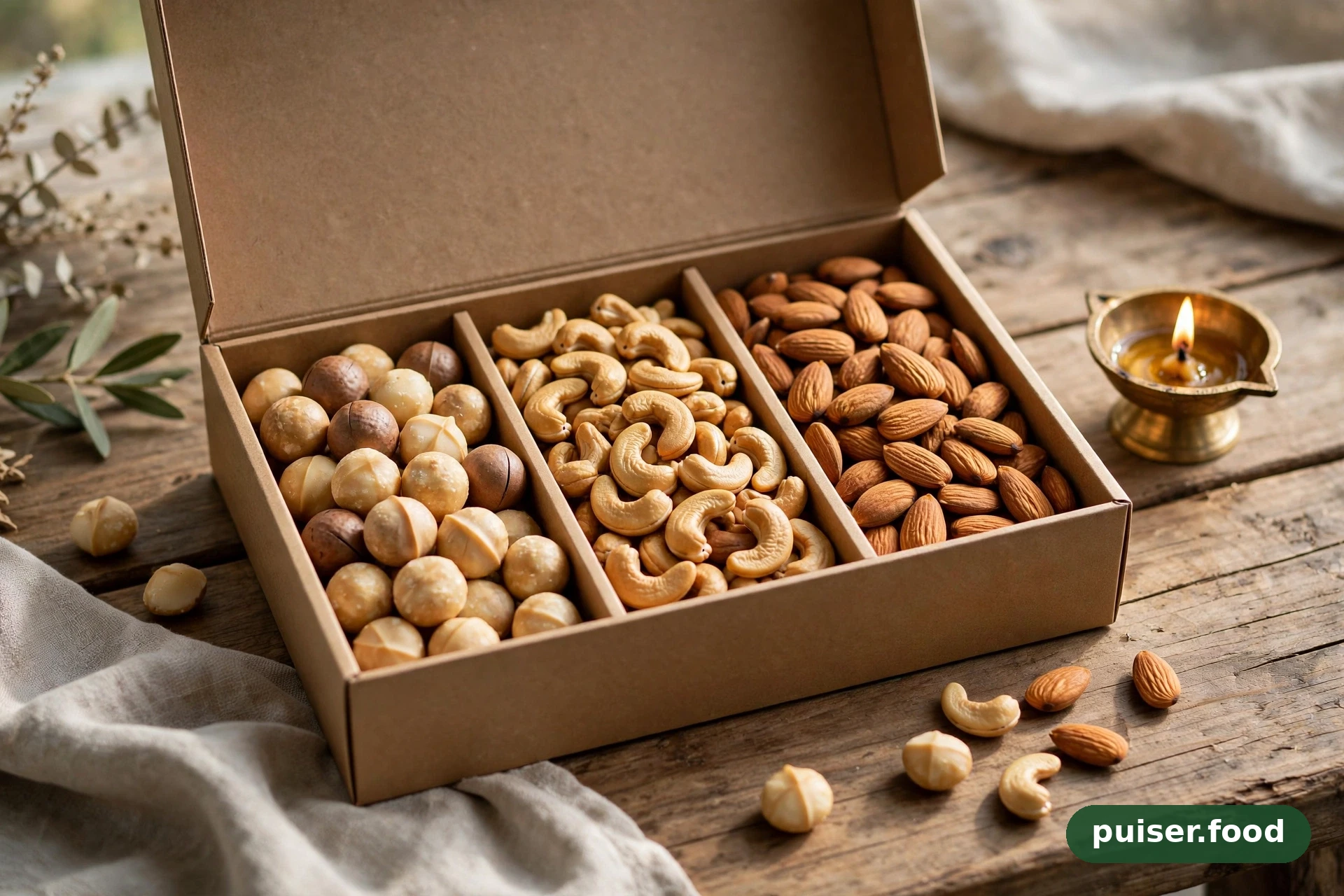
In India the macadamia plays a different role from the cashew, its rival in the gifting box. The cashew is the everyday nut, cheap enough to cook with and familiar enough to eat by the handful, while the macadamia is the premium nut, bought for a festival box, a box of cookies or a special mithai. Our cashews benefits guide covers the gifting box rival in the same detail as this one, and the comparison is worth making before you buy, because the macadamia costs much more than the cashew for a nut that gives fewer grams of protein per rupee. What it gives instead is flavour and fat quality, and that is the reason to buy it.
Macadamia Nuts in Numbers
The numbers behind the macadamia nuts benefits come from one USDA record, and this guide uses that record only. USDA FoodData Central holds a record for macadamia nuts, FDC ID 170178, “Nuts, macadamia nuts, raw”, from the SR Legacy dataset, and every figure below is from that record unless a portion is named. A different record, FDC ID 2707503, covers salted nuts at 353 mg of sodium per 100 g, so it is not used here. All figures are per 100 g unless a portion is named.
| Nutrient, macadamia nuts raw (per 100 g) | Amount |
|---|---|
| Energy | 718 kcal |
| Protein | 7.91 g |
| Fat | 75.77 g |
| Carbohydrates | 13.82 g |
| Fibre | 8.6 g |
Three figures in that table do most of the work. Energy at 718 kcal per 100 g is the highest of the common nuts, and it is the figure that sets the portion. Fat at 75.77 g per 100 g is the reason for it. Protein at 7.91 g and fibre at 8.6 g per 100 g are the lowest of the common nuts, so the nut cannot carry a meal the way a dal can.
| Fat (per 100 g) | Amount |
|---|---|
| Total fat | 75.77 g |
| Monounsaturated fat | 58.88 g |
| Oleic acid | 43.8 g |
| Palmitoleic acid | 13.0 g |
| Saturated fat | 12.06 g |
| Polyunsaturated fat | 1.50 g |
The fat table is where the macadamia earns its reputation. Monounsaturated fat at 58.88 g per 100 g is most of the fat in the nut, and oleic acid at 43.8 g is the largest single part of it. Palmitoleic acid at 13.0 g per 100 g is the unusual figure, far higher than in other common nuts, and it is the reason researchers keep studying this nut. Saturated fat at 12.06 g per 100 g is higher than in many nuts, and polyunsaturated fat at 1.50 g per 100 g is low.
| Portion of macadamia nuts | Energy | Protein | Fat | Fibre |
|---|---|---|---|---|
| 15 g, about 5 kernels | 108 kcal | 1.2 g | 11.4 g | 1.3 g |
| 28 g, 1 oz, 10 to 12 kernels | 204 kcal | 2.2 g | 21.2 g | 2.4 g |
| 50 g, a small handful | 359 kcal | 4.0 g | 37.9 g | 4.3 g |
| 134 g, 1 cup whole or halves | 962 kcal | 10.6 g | 101.5 g | 11.5 g |
The portion table above is calculated from the per 100 g figures in the USDA record, and it is the table to cook by. One ounce, 28 g, is the serving this guide uses everywhere, about 10 to 12 kernels, and it gives 204 kcal with 2.2 g of protein and 2.4 g of fibre. A cup of whole or halved nuts weighs 134 g and gives 962 kcal, so the cup is a measure for a recipe, never a serving.
| Mineral (per 100 g) | Amount | Per 28 g serving |
|---|---|---|
| Manganese | 4.13 mg | 1.16 mg |
| Thiamin (vitamin B1) | 1.195 mg | 0.33 mg |
| Magnesium | 130 mg | 36 mg |
| Iron | 3.69 mg | 1.03 mg |
| Potassium | 368 mg | 103 mg |
| Calcium | 85 mg | 24 mg |
| Sodium | 5 mg | 1.4 mg |
The mineral table is the quiet half of the nut. Manganese at 4.13 mg per 100 g is the standout, and a 28 g serving gives 1.16 mg. Thiamin at 1.195 mg per 100 g is high for a nut, and a serving gives 0.33 mg. Magnesium at 130 mg and iron at 3.69 mg per 100 g are useful in a small serving, and potassium at 368 mg sits beside sodium at only 5 mg per 100 g.
10 Macadamia Nuts Benefits Worth Knowing
Here are the ten macadamia nuts benefits worth knowing, in the order a home cook would care about them. Each one is tied to a number from the tables above, and each one belongs to a serving of 10 to 12 kernels, not to a cupful.
1. Monounsaturated fats that lead the nut shelf
The first reason is the fat quality. Macadamia nuts give 58.88 g of monounsaturated fat per 100 g, most of the 75.77 g of total fat, and oleic acid at 43.8 g is the largest single part of it. A 28 g serving gives about 16.5 g of monounsaturated fat.
2. Palmitoleic acid, unusually high for a nut
Palmitoleic acid at 13.0 g per 100 g is the figure that sets the macadamia apart from every other common nut. Researchers study this fatty acid for its links to metabolism, and the honest limits are told below.
3. Manganese in a small serving
Macadamia nuts give 4.13 mg of manganese per 100 g, and a 28 g serving gives 1.16 mg, which is a useful share from 10 to 12 kernels. Manganese helps the body use energy from food and supports bone health. The serving is small, so the nut is a top up beside dal, vegetables and whole grains.
4. Thiamin for everyday energy
Thiamin, vitamin B1, sits at 1.195 mg per 100 g, high for a nut, and a 28 g serving gives 0.33 mg. Thiamin helps the body turn food into energy.
5. Magnesium and iron in the same handful
A 28 g serving gives 36 mg of magnesium and 1.03 mg of iron, from 130 mg and 3.69 mg per 100 g. Magnesium supports muscles and steady energy, and iron supports the blood. The iron is from a plant source, so it absorbs better with vitamin C from fruit or a lemon dressed salad.
6. Low in carbohydrate for a nut
Macadamia nuts give 13.82 g of carbohydrates per 100 g, low beside most nuts and grains, with 8.6 g of fibre alongside.
7. Naturally gluten free
The nut is naturally gluten free, because it is a tree nut and not a grain. Check the pack for a gluten free label when the nuts are packed in a shared facility, because cross contact is possible there.
8. Keeps you full on a few kernels
Fat and fibre together slow digestion, so a few kernels keep you full for longer than their size suggests. A 28 g serving gives 21.2 g of fat and 2.4 g of fibre, and that richness is why a small handful satisfies.
9. Flavour that carries a dish
The macadamia tastes mild, creamy and faintly sweet, and that flavour carries a dish with very little help. A few chopped kernels lift a salad, a cookie or a burfi. That is what makes it a gifting nut, because the flavour reads as premium on its own. Our pecans benefits guide covers the other buttery nut, and our hazelnuts benefits guide covers the nut that suits chocolate dishes better.
10. One nut, many uses
The macadamia works whole, halved, chopped and ground, and the four forms cover snacking, salads, baking and mithai. Whole kernels suit a gift box and a snack, chopped kernels suit salads and cookies, and ground macadamia suits a burfi and a dough. The nut keeps for months in a jar when stored right, so one pack covers many dishes. Our Brazil nuts benefits guide covers the other premium nut best eaten in very small numbers, and the two make a useful pair in a gift box.
The Healthy Fat Story, Honestly
The macadamia nuts benefits that get quoted most often are also the ones with the thinnest evidence, so they deserve a straight telling, along with the calorie and saturated fat figures beside them. None of the three is a reason to skip the nut, only to eat it in a small portion.
The calorie and protein truth, first
Macadamia nuts give 718 kcal per 100 g, the highest energy of the common nuts, and protein at 7.91 g per 100 g and fibre at 8.6 g per 100 g are the lowest of the same group. A 28 g serving gives 204 kcal with only 2.2 g of protein, so the nut is a fat food first and a protein food last. A handful a day fits a healthy plate, and a cupful at 962 kcal does not, so count the kernels and let the protein come from dal, curd or milk.
The cholesterol trials are small
The cholesterol story rests on small trials, and the one most often quoted ran for 8 weeks with 35 adults and found about a 2 percent drop in total cholesterol. That is a small study with a small result, not proof that eating the nuts lowers cholesterol for everyone. The fat profile gives a reason to hope, and the trial gives a reason to stay modest. Anyone managing cholesterol should ask their own doctor about portions rather than treating the nut as medicine.
The metabolic syndrome claims rest on a review
Claims about metabolic syndrome rest on a 2022 review of the research, not on a macadamia trial, and a review can only gather what the trials underneath it show. The review looked at palmitoleic acid and related fats, and it found reasons for interest rather than proof. That is worth knowing before a pack or a post promises more than the evidence holds. The nut is worth eating for its fat quality and flavour, which are measured, and the metabolic story can wait for a proper trial.
Saturated fat is worth knowing
Saturated fat at 12.06 g per 100 g is higher than in many nuts, and it sits beside the 58.88 g of monounsaturated fat in the same kernel. The balance still favours the healthy fats, and a 28 g serving gives about 3.4 g of saturated fat, which is a modest share of a day. The figure matters most for a cook who eats nuts by the cupful. In a counted serving, it is a footnote rather than a warning.
Toxic to dogs, and a tree nut allergy applies
Macadamia nuts are toxic to dogs, and even a small number can make a dog ill, with weakness, vomiting and tremors among the signs reported. Keep the nuts, the cookies and the mithai that contain them away from dogs, and ask a vet at once if a dog eats any. The nut is also a tree nut, so people with a tree nut allergy should avoid it entirely, and a kitchen serving guests should say when a dish contains macadamia.
Raw, Roasted and Salted, Whole and Chopped
The macadamia nuts benefits change little between the forms on the shelf, because the kernel is the same, but they change between the ways it is sold. Raw macadamia nuts are the plain kernel, unsalted, and they carry the figures in the tables above, with sodium at only 5 mg per 100 g. Roasted nuts taste deeper and crunchier, and dry roasted packs stay close to the raw figures, while oil roasted packs add fat.
The kernel is sold whole, as halves and chopped, and the form suits the dish rather than the nutrition. Whole kernels suit a gift box and a small snack, halves suit salads and baking, and chopped kernels suit cookies, burfi and a crumble topping. Macadamia butter is the ground form, smooth and rich, and it suits toast and baking, though a spoonful carries the same calories as the kernels. Buy raw and whole for everyday eating.
Five Everyday Ways to Use It
The macadamia nuts benefits show up best in five everyday dishes, each one using a small serving of 10 to 12 kernels rather than a cupful, with the nuts chopped or halved so the flavour spreads.
1. Macadamia burfi with cardamom
Grind a small handful of macadamia nuts coarse, cook them gently with milk, sugar and cardamom on a low flame, and set the mix in a greased steel plate. The nuts give the burfi its creamy body, so it needs less ghee than a cashew burfi. Cut it into small squares and serve it at a festival or with evening chai.
2. Macadamia cookies with jaggery
Chop the nuts and fold them into a cookie dough sweetened with jaggery, then bake until the edges turn golden and the centres stay soft. The nuts stay crunchy inside the cookie, and the jaggery gives a deeper sweetness. The cookies keep well in a steel dabba, so they suit a tiffin box and a tea tray.
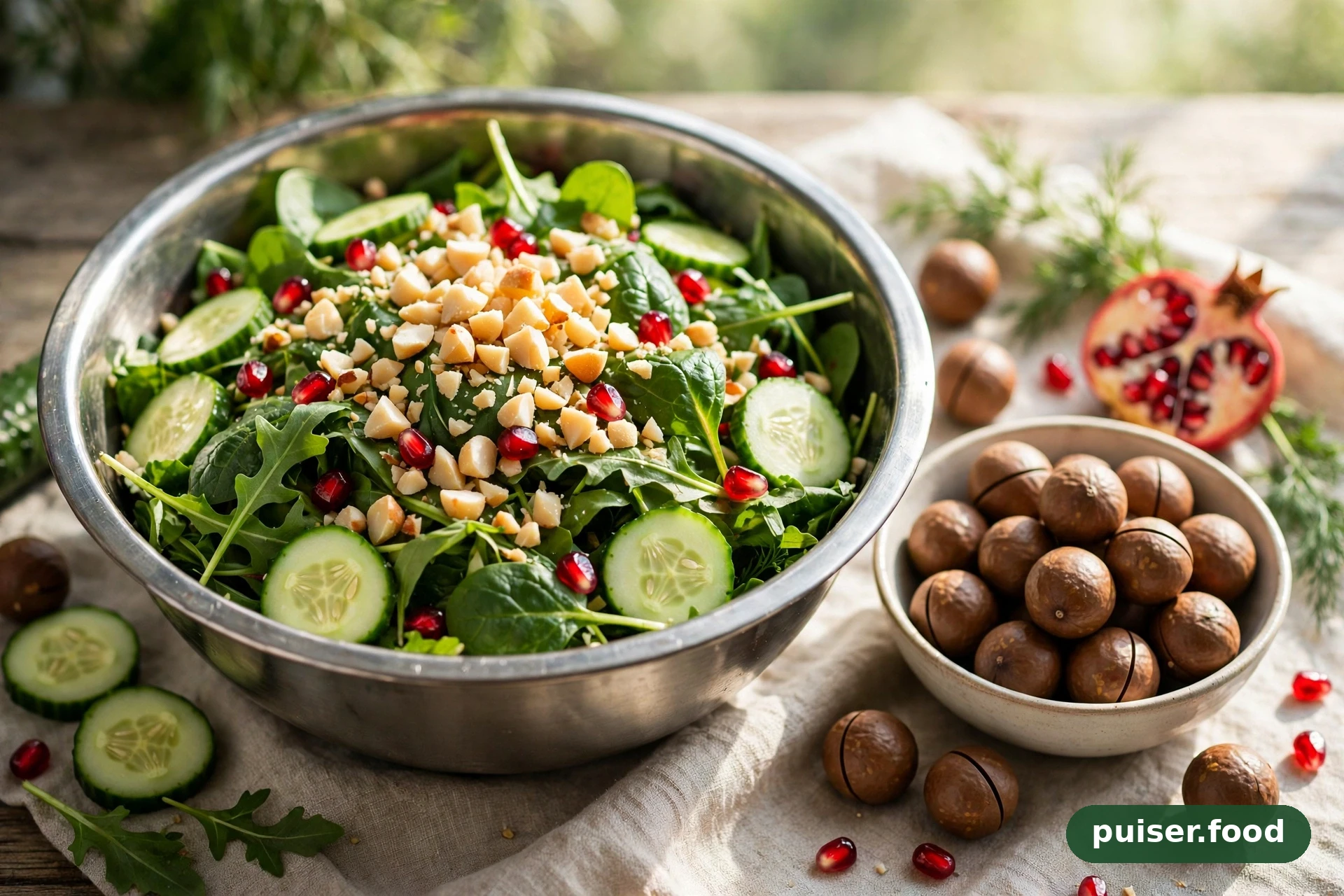
3. Macadamia salad with cucumber and pomegranate
Toss chopped macadamia nuts with cucumber, tomato and onion, pomegranate seeds and coriander, then dress with lemon juice, salt and a little olive oil. The nuts give the salad its richness, and the lemon keeps it fresh. Serve it as a light lunch or beside a dal and roti dinner.
4. Macadamia trail mix for the evening
Mix a counted handful of macadamia nuts with roasted chana, pumpkin seeds and a few raisins, and keep the mix in a small dabba. The chana adds the protein the macadamia lacks, and the raisins add a little sweetness. The mix suits a walk or a long evening at work, and the small dabba keeps the portion honest.
5. Macadamia kheer with cardamom
Simmer a small handful of chopped macadamia nuts in milk on a low flame, stirring often, until the milk thickens, then add cardamom and a little jaggery and finish with chopped pistachios. The nuts give the kheer its creamy body, so it needs less sugar than a rice kheer. Serve warm in a steel bowl, or chill it for a summer dessert.
Buying and Storing Macadamia Nuts
The macadamia nuts benefits survive or die on the label, so buy by the label, not by the price alone. The ingredients list should read macadamia nuts, and a pack that lists anything else is a mix or a coated snack. Whole kernels keep longest, and chopped nuts go stale fastest because the fat is exposed to air, so buy chopped nuts in small packs and use them within weeks. A pack that smells stale or rancid will taste worse after cooking.
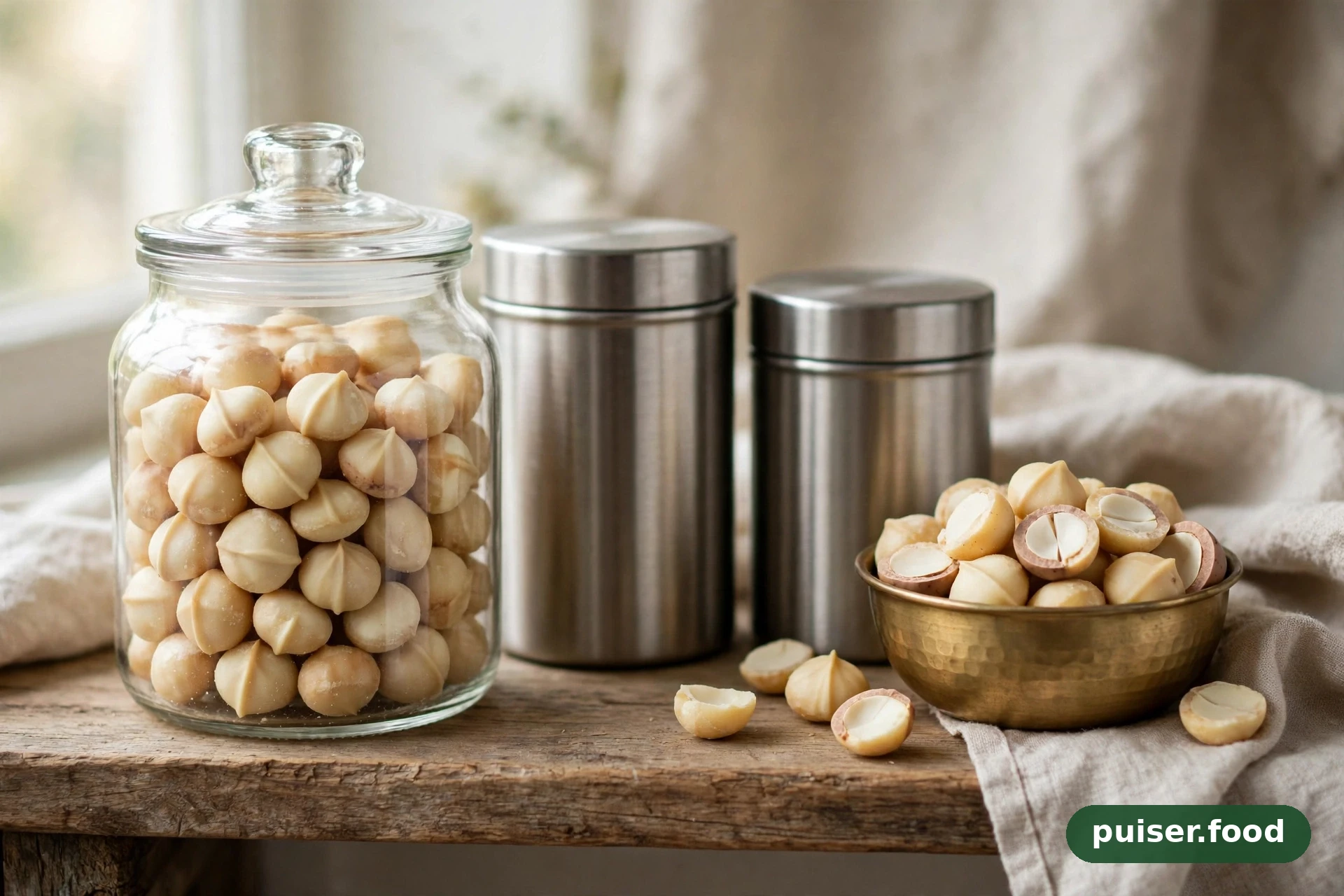
For the pantry, our Organic Cashews are the plain whole kernels in the Puiser shop, made for the burfi, the cookies and the salad. Store the nuts in an airtight jar in a cool, dark place, where they keep for months, and keep an opened pack in the fridge in summer, because the fat goes rancid in heat. Throw the nuts away if they smell stale or rancid, or if they show mould.
5 Expert Tips
Five small habits keep the macadamia nuts benefits on the plate and the calories counted.
1. Count 10 to 12 kernels. Count 10 to 12 kernels into a small bowl and put the pack away, because a handful grows easily past 204 kcal without feeling like much food.
2. Chop them, do not eat them whole from the pack. Chop the nuts before they go into a dish, because chopping spreads the flavour, and a few kernels then do the work of many.
3. Toast them lightly. Toast the kernels in a dry kadhai on a low flame until they smell nutty, because the heat brings out the flavour and keeps the nuts crunchy in a salad. Watch the pan, because the high fat means they brown fast.
4. Pair them with protein. Pair the nuts with roasted chana, dal, curd or milk, because the nut gives only 2.2 g of protein in a serving.
5. Store them in the fridge in summer. Store an opened pack in an airtight jar in the fridge in summer, because heat turns the fat rancid faster than in a leaner nut.
Common Mistakes to Avoid
Eating them by the cupful. A cup of macadamia nuts weighs 134 g and gives 962 kcal. Count 10 to 12 kernels and put the pack away.
Treating them as a protein food. Macadamia nuts give 7.91 g of protein per 100 g, the lowest of the common nuts, while dals give far more by weight. Pair them with dal or curd, and do not let them carry the meal’s protein alone.
Buying salted packs by mistake. Salted macadamia nuts carry far more sodium than the raw nut at 5 mg per 100 g, so a salted pack is a different food. Read the label and buy raw nuts for everyday eating.
Leaving them open in summer. The nut carries 75.77 g of fat per 100 g, so an open pack in summer heat goes rancid fast. Keep the nuts in an airtight jar in the fridge once the weather turns hot.
Sharing them with dogs. Macadamia nuts are toxic to dogs, and even a few kernels can make a dog ill. Keep the nuts and any dish that contains them away from dogs, and ask a vet at once if a dog eats any.
Frequently Asked Questions
What are the main benefits of macadamia nuts?
Macadamia nuts benefits centre on healthy fats, minerals and flavour, with raw nuts giving 58.88 g of monounsaturated fat, 13.0 g of palmitoleic acid and 4.13 mg of manganese per 100 g. The fat is mostly monounsaturated, and the nut is naturally gluten free. The portion is 10 to 12 kernels a day.
How many macadamia nuts should I eat in a day?
About 10 to 12 kernels a day, one ounce or 28 g, is the daily portion this guide uses, with about 204 kcal, 2.2 g of protein and 2.4 g of fibre. The nuts are small and creamy, so a handful grows easily past that. Count the kernels into a small bowl and put the pack away.
Are macadamia nuts good for weight loss?
A counted serving of 10 to 12 kernels suits a weight loss diet better than a large bowl of a lighter snack, because the fat and fibre make it filling. The catch is the portion. The serving gives 204 kcal, and a second handful adds another 204 kcal without feeling like much more food.
Are macadamia nuts good for cholesterol?
The fat profile gives a reason to hope, because most of the fat is monounsaturated, but the trials are small. One 8 week trial with 35 adults found about a 2 percent drop in total cholesterol, which is a small result from a small study. People managing cholesterol should ask their own doctor about portions.
Are macadamia nuts good for diabetes?
Macadamia nuts give 13.82 g of carbohydrates per 100 g, low for a nut, with 8.6 g of fibre alongside, so a serving adds little carbohydrate to a plate. The fibre slows it down, and pairing the nuts with vegetables helps further. People with diabetes should ask their own doctor about portions before eating them daily.
Are macadamia nuts good for children?
Children can eat macadamia nuts in small servings, and the chopped nuts suit cookies, burfi and kheer well, because the kernel is soft and creamy. The nuts are a choking risk for very young children, so chop them fine and watch young children while they eat. Keep the portion small, and keep the nuts away from dogs.
Can dogs eat macadamia nuts?
No, macadamia nuts are toxic to dogs, and even a small number can make a dog ill, with weakness, vomiting and tremors among the signs reported. Keep the nuts, the cookies and the mithai that contain them away from dogs. Ask a vet at once if a dog eats any macadamia nuts.
Are raw macadamia nuts better than roasted or salted?
Raw macadamia nuts are the plain kernel, with sodium at only 5 mg per 100 g, and they suit everyday eating best. Dry roasted nuts stay close to the raw figures, while oil roasted packs add fat. Salted packs carry far more sodium, so they are a different food, and the label is worth reading before you buy.
Are macadamia nuts gluten free?
Yes, macadamia nuts are naturally gluten free, because they are the kernels of a tree and not a wheat, barley or rye grain. The nuts make safe burfi, cookies and salads for people who avoid gluten. Buy packs labelled gluten free when the nuts are packed in a shared facility, because cross contact is possible there.
Do macadamia nuts have side effects?
The main cautions are the calories, the tree nut allergy and the risk to dogs. A cupful gives 962 kcal, so count 10 to 12 kernels a day. People with a tree nut allergy should avoid the nut entirely. The nuts are toxic to dogs, so keep them away from pets.
Conclusion
Macadamia nuts earn their place in the pantry when the portion is 10 to 12 kernels, the nuts are counted before they go into a bowl, and the health claims are kept honest. The macadamia nuts benefits, the monounsaturated fats, the palmitoleic acid and the minerals, make it the creamiest nut on the shelf, and the burfi, the cookies and the salad give it five easy uses. Try a small handful in a salad, in cookies or in a burfi.
Disclaimer: This article is for general information only and is not medical advice. If you have a tree nut allergy, diabetes, or high cholesterol, talk to your doctor before making macadamia nuts a daily habit. Keep macadamia nuts away from dogs.