Introduction
Prunes are the dried plums of the Indian kitchen, the dark, wrinkled fruit that stews in a bowl at breakfast, sweetens a chutney and sits in the dry fruit box beside the raisins and figs. Most people know them for one thing only, and the honest question is whether they earn a wider place as a health food or only as a laxative. This guide covers the prunes benefits that matter most, the fibre and sorbitol numbers told honestly, the bone health evidence with both views, and the five dishes where prunes work best.
In this article
- The short answer
- What prunes actually are
- Prunes in numbers
- 10 benefits worth knowing
- Sorbitol and the laxative dose, honestly
- Prunes versus aloo bukhara
- Five everyday ways to use them
- Buying and storing prunes
- 5 expert tips
- Common mistakes to avoid
- Frequently asked questions
- Conclusion
The Short Answer
The prunes benefits that matter most are fibre, sorbitol and potassium in a dried fruit that needs no cooking at all. A 100 g portion of prunes gives about 7.1 g of fibre and 732 mg of potassium for about 240 kcal, and four prunes, about 40 g, give about 96 kcal and 2.8 g of fibre. Prunes are sugar dense, about 38 g of sugars per 100 g, so three to five a day is the portion, and they suit the stewed bowl, the chutney and the trail mix best.
What Prunes Actually Are
Prunes, called dried plums in English and often sold as aloo bukhara in India, are plums that have been dried in the sun or in a dryer until most of the water is gone and the sugars are concentrated. The plum is Prunus domestica, the European plum, and the drying takes days, during which the fruit shrinks, darkens and turns soft and chewy. India imports most of its prunes from the United States, Chile and France, and the fruit holds a place in Indian kitchens that no other dried fruit quite matches, in the stewed bowl of breakfast, in the chutney of a feast, and in the dry fruit box of the health conscious.
That prunes carry fibre, sorbitol and potassium with their sugar is the first thing to understand, because it is what separates a prune from a sweet, and it is where the prunes benefits start. A prune gives natural sugars with fibre, potassium, vitamin K and copper attached, and the fibre slows the digestion a little, the sorbitol draws water into the gut, and the fruit still tastes like toffee, which is why prunes work as a remedy and a snack at once.
Prunes are also the fruit of the breakfast bowl and the Kashmiri kitchen, in the stewed prunes of the morning, in the aloo bukhara chutney of a wazwan, in the trail mix of a train journey, and in the porridge of a hospital diet. Our raisins benefits guide covers the small sweet fruit of the kheer, the one to reach for when the question is kishmish rather than prunes. Our dates benefits guide covers the other sweet dried fruit of the same shelf, the one to reach for when the question is khajur rather than prunes.
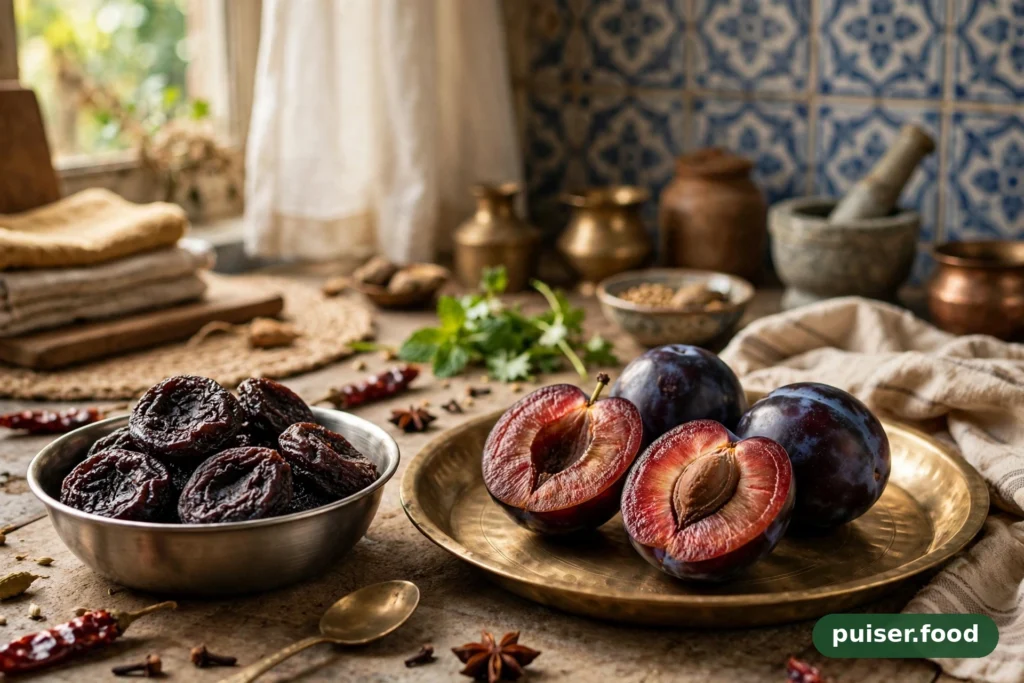
Prunes in Numbers
The table below sets out the prunes benefits in numbers, and it uses one basis throughout. The figures are from USDA FoodData Central, for plums, dried (prunes), uncooked, per 100 g, and they are the figures this guide uses throughout. The fibre figure, 7.1 g per 100 g, is the one that matters most, and it is the figure that separates prunes from sugar, honey and jaggery, so it can be checked two ways.
| Nutrient (per 100 g prunes) | Prunes |
|---|---|
| Energy | 240 kcal |
| Protein | 2.18 g |
| Fat | 0.38 g |
| Carbohydrates | 63.88 g |
| Dietary fibre | 7.1 g |
| Sugars | 38.13 g |
| Calcium | 43 mg |
| Iron | 0.93 mg |
| Magnesium | 41 mg |
| Phosphorus | 69 mg |
| Potassium | 732 mg |
| Sodium | 2 mg |
| Vitamin K | 59.5 mcg |
| Copper | 0.281 mg |
| Vitamin A | 781 IU |
| Niacin | 1.882 mg |
| Riboflavin | 0.186 mg |
Figures per USDA FoodData Central, plums, dried (prunes), uncooked, per 100 g. The potassium, 732 mg per 100 g, is the standout mineral, and a portion of four prunes gives about 293 mg, which is about a twelfth of the 3,500 mg a day that health bodies suggest adults aim for. The vitamin K, 59.5 mcg per 100 g, is about half of what adults need in a day, and this guide covers below why that matters for people on warfarin, because prunes are often sold as a bone food and the vitamin K is part of the story.
The second table shows what a real portion gives you. Four prunes, about 40 g, give about 96 kcal and 2.8 g of fibre, which is a sensible daily portion. A 100 g portion, about a small bowl, gives about 240 kcal and 38 g of sugars, which is about 10 teaspoons of sugar, and that is why the handful is the portion and the bowl is not.
| Portion | Energy | Fibre | Potassium | Price, at 499 rupees per 500 g |
|---|---|---|---|---|
| 100 g prunes | 240 kcal | 7.1 g | 732 mg | About 100 rupees |
| 4 prunes, about 40 g | About 96 kcal | About 2.8 g | About 293 mg | About 40 rupees |
| 1 prune, about 10 g | About 24 kcal | About 0.7 g | About 73 mg | About 10 rupees |
| 1 small bowl stewed, about 50 g | About 120 kcal | About 3.6 g | About 366 mg | About 50 rupees |
Figures per USDA FoodData Central, scaled to the portion. Prices are worked out from prunes at 499 rupees for 500 g, about 100 rupees per 100 g, so four prunes cost about 40 rupees and a 500 g pack gives about 12 portions of four prunes. Imported prunes cost far more, about 846 rupees for 500 g, so the handful maths above is for the everyday Indian pack, and the imported handful costs about 68 rupees.
The third table compares prunes with the other sweet dried fruits of the Indian kitchen. Prunes win on sugar, carrying the least of the four, and no other dried fruit in the table beats them on fibre and sorbitol together. Anjeer carries more fibre and calcium, raisins carry a little more potassium, and dates carry more sugars, but the prune is the only one that leads on digestion and the lowest sugar at once.
| Food, per 100 g | Energy | Sugars | Fibre | Potassium | Best use |
|---|---|---|---|---|---|
| Prunes | 240 kcal | 38.1 g | 7.1 g | 732 mg | Digestion, stewed fruit |
| Anjeer, dried figs | 249 kcal | 47.9 g | 9.8 g | 680 mg | Soaked handful, milkshake, barfi |
| Raisins, dark seedless | 299 kcal | 59.2 g | 3.7 g | 749 mg | Kheer, poha, trail mix |
| Dates, Medjool | 277 kcal | 66.5 g | 6.7 g | 696 mg | Handful, laddoo, sweetener |
Comparison per USDA FoodData Central, on the same basis: prunes, anjeer FDC #174665, raisins FDC #168165, dates FDC #169655. The sugar gap is the story of the table: prunes carry about 38 g of sugars per 100 g, dates carry about 66 g, and raisins carry about 59 g, which is why prunes are the gentlest sweet of the dried fruit shelf, even if four a day is still the portion.
10 Benefits Worth Knowing
These are the ten prunes benefits worth knowing, in the order that matters for an Indian kitchen. The first three are the nutrition facts. The rest are what those facts mean in practice, including the honest limits.
1. Fibre that keeps digestion moving
At 7.1 g of fibre per 100 g, prunes give a useful amount of fibre for a dried fruit, and that is the first of the prunes benefits, because four prunes give about 2.8 g, and the fibre adds bulk to the stool and feeds the good bacteria in the gut. The fibre is the reason prunes help with constipation when eaten daily with enough water. The fibre also slows the sugars down a little, so a prune is digested more slowly than the same weight of sugar.
2. Sorbitol, the natural laxative
At about 14.7 g of sorbitol per 100 g, prunes carry more of the sugar alcohol than any other common fruit, and four prunes give about 5.9 g. Sorbitol draws water into the gut and softens the stool, and it is the reason prunes work as a laxative where other dried fruits only help a little. The sorbitol section below covers the dose that helps and the dose that hurts, because the same compound that helps at four prunes a day causes gas and loose stools at ten.
3. Potassium for blood pressure
At 732 mg of potassium per 100 g, prunes are a useful source of the mineral that helps regulate blood pressure, and four prunes give about 293 mg. Potassium works against the sodium in the diet, so a potassium rich food is a useful part of a blood pressure friendly diet, and prunes carry almost no sodium of their own, about 2 mg per 100 g. Prunes do not treat high blood pressure, but the potassium is one more reason the handful works as a daily habit.
4. Vitamin K for bones, with a warfarin catch
At 59.5 mcg of vitamin K per 100 g, prunes carry about half of what adults need in a day, and four prunes give about 23.8 mcg. Vitamin K helps the body use calcium for bones, and it is the reason prunes are named in bone health trials. The catch is warfarin: the blood thinner works against vitamin K, so people on warfarin should keep their prune intake steady and ask their prescriber before starting a daily habit. The bone section below covers the trials, and the warfarin caution stays with them.
5. Iron, modest but honest
At 0.93 mg of iron per 100 g, prunes carry a modest amount of the mineral, and four prunes give about 0.37 mg. The amount is small beside a bowl of dal, and the body absorbs only a little of the iron in prunes, so prunes are a poor choice as an iron remedy, whatever the packet claims. Prunes still belong in an iron rich diet, because the vitamin C in the meal helps the body absorb iron from other foods, but the prune itself is not the iron source.
6. A low glycaemic index for a dried fruit
Prunes have a glycaemic index of about 29, which is low, far below white bread or sugar, because the fibre and sorbitol slow the digestion of its own sugars. That makes prunes the gentlest sweet of the dried fruit shelf for people watching blood sugar, and it is the reason prunes are often recommended as a diabetes friendlier snack. But prunes do raise blood sugar, and the benefit is in the portion, not in the fruit alone, because four prunes give about 15 g of sugars.
7. Antioxidants that dried fruit does well
Prunes carry phenols and other plant compounds that act as antioxidants in the body, and studies that compare dried fruits rank prunes among the richest for total antioxidant content. The dark colour of the prune comes from these compounds, and drying concentrates them along with the sugars, so the prune carries more of them per bite than the plum it came from. Antioxidants are not a reason to eat prunes by the bowlful, but they are a real extra on top of the fibre and potassium.
8. Bone support, promising but not proven
Trials in postmenopausal women suggest prunes may help preserve bone, and the prunes benefits for bones are promising, not proven, which is the level this guide keeps the claim at. The trials used about five or six prunes a day, eaten for months, and they found less bone loss in the prune eaters than in the women who ate none. The trials were small, and the evidence is limited, so prunes support a bone friendly diet, and they do not treat osteoporosis or replace calcium, vitamin D or exercise.
9. A sweetener that replaces sugar in the stew
Prunes work as a whole fruit sweetener, stewed into porridge, simmered into chutney, and chopped into cakes in place of some of the sugar, and the swap brings fibre and potassium where sugar brings nothing. The fruit sweetens as it cooks, and a handful in the stew means a spoon less of sugar in the pot.
10. A fruit that works in sweet and savoury cooking
Prunes work in more dishes than any other dried fruit, in stewed fruit, in chutney, in pulao, in tagines, in trail mix and in the porridge. The toffee flavour suits sweet dishes best, and the soft flesh plumps up in cooking, which is why a handful in hot milk or rice tastes so much better than a handful from the jar.
Sorbitol and the Laxative Dose, Honestly
Sorbitol is where the prunes benefits get argued about most, and the honest version starts with the number. At about 14.7 g of sorbitol per 100 g, prunes carry more of the sugar alcohol than any other common fruit, and four prunes give about 5.9 g. Sorbitol is poorly absorbed in the gut, so it draws water in and softens the stool, and that is the mechanism behind the prune’s reputation. The fibre adds to it, and the two together are why prunes work better than other dried fruits for constipation.
The catch is the dose and the gas. Three to five prunes a day help most people stay regular, and the effect usually shows within a day. More than eight or ten a day commonly causes gas, bloating and loose stools, because the gut cannot absorb that much sorbitol at once. People with irritable bowel syndrome are the most sensitive, and they should start at two prunes a day and raise the dose slowly. The prunes benefits for digestion are real, and they are dose dependent, which is why this guide names the dose instead of calling the fruit a cure.
The stewed prune belongs here too, because stewing makes the fruit softer and easier to digest, and the water it stews in carries a little of the sorbitol. A small bowl of stewed prunes at breakfast is the gentlest way to take the dose, and it suits older people and children.
Prunes Versus Aloo Bukhara
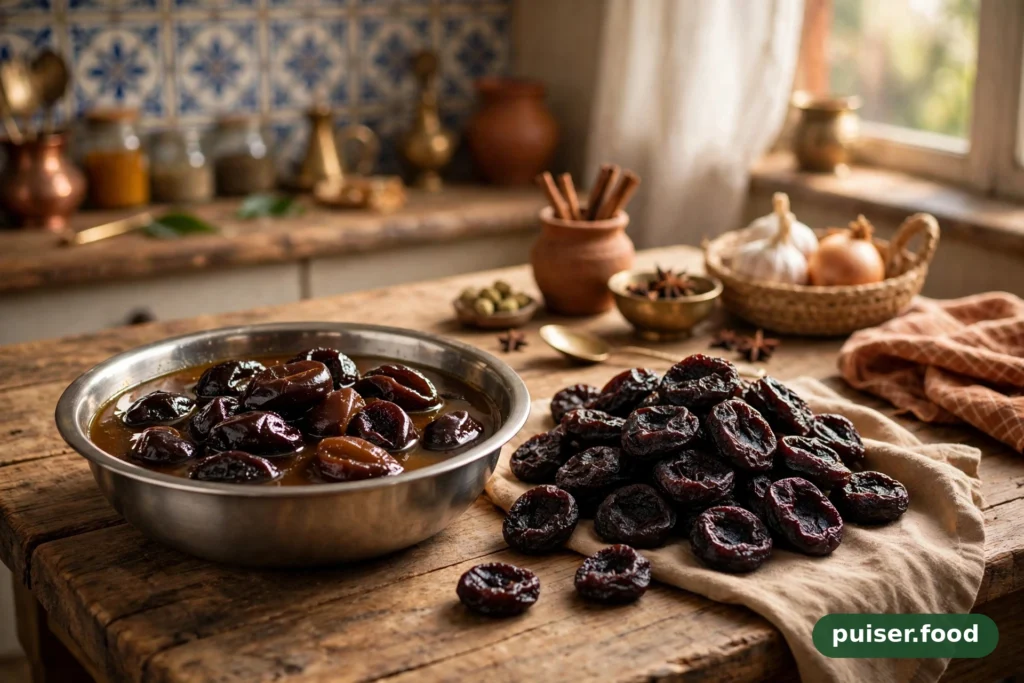
Aloo bukhara is the name most Indian shoppers know, and the question is whether it is the same fruit as the prune. The answer is mostly yes: aloo bukhara is the Hindi and Urdu name for the dried plum, and the prunes sold in Indian markets are usually labelled aloo bukhara. The Kashmiri aloo bukhara is the fresh plum, dried in the sun, and it is smaller, darker and tangier than the Californian prune, which is larger, softer and sweeter. The nutrition barely changes between the two, so the choice is mostly one of taste, texture and price.
For daily eating, the market aloo bukhara is the right buy, because it is soft enough when stewed, sweet enough for a chutney, and cheap enough to eat four a day without thinking about the price. For a gift box, the Californian prune is the right buy, because no other prune looks or tastes as rich. For cooking, the Kashmiri kind is the right buy, because it holds its shape in a chutney and does not turn to mush. Fresh plums are a different fruit altogether, juicy and perishable, and they suit the fruit bowl, not the jar.
The dried plum also comes in two forms that confuse buyers. The soft, moist prune in a sealed pack is the one to buy, and the hard, dry prune in an open sack is the one to avoid, because it has lost its moisture and its flavour. Some cheap prunes are coated in sugar syrup to make them shine, so buy prunes with no added sugar, no glucose and no preservatives listed. The vitamin K question belongs here too: prunes carry about 59.5 mcg per 100 g, so people on warfarin should keep their intake steady, as the bone section said.
Five Everyday Ways to Use Them
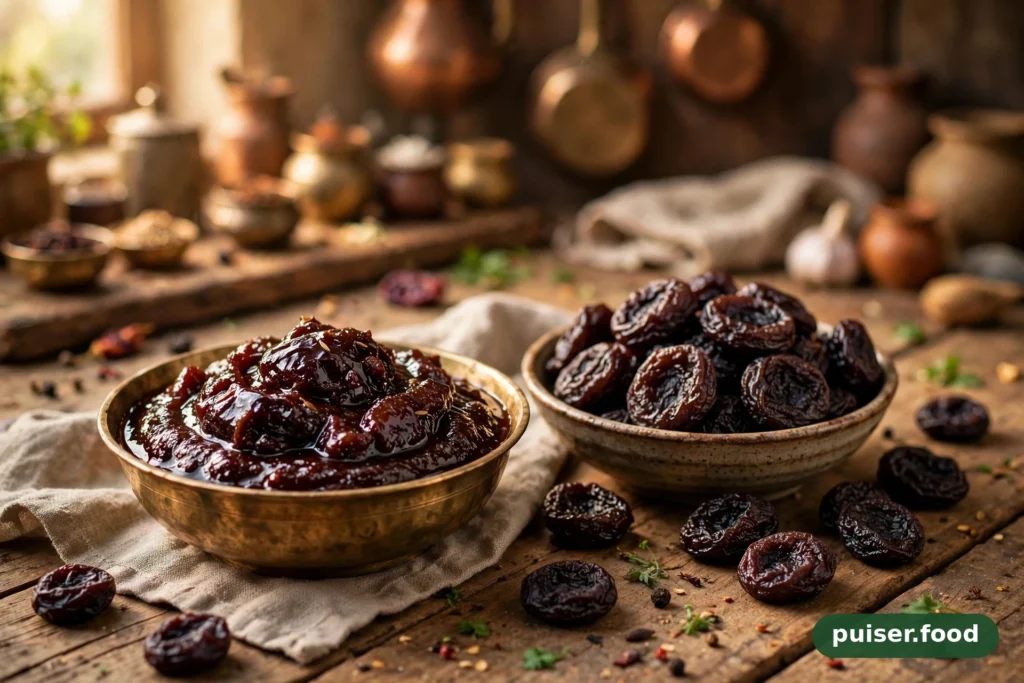
Prunes show up in five everyday dishes. First, three to five prunes a day, the handful that needs no cooking. Second, stewed prunes, the fruit simmered in water until soft and served warm at breakfast. Third, aloo bukhara chutney, prunes cooked with vinegar, jaggery and spices, the tangy side that suits kebabs and pulao. Fourth, porridge and curd, chopped prunes stirred into the morning bowl, the garnish that sweetens a plain breakfast. Fifth, trail mix, prunes with peanuts, makhana and seeds, the snack that travels in a pocket.
Our apricots benefits guide covers the golden dry fruit of the same shelf, the one to reach for when the question is khubani rather than prunes. Our anjeer benefits guide covers the calcium rich fig of the same shelf, the one to reach for when the laddoo needs a softer sweet.
Buying and Storing Prunes
The prunes benefits survive or die on whether the prunes are fresh, because old prunes dry out, turn hard and lose their soft chew. Good prunes are plump, soft and glossy, with unbroken skin and no white sugar crystals on the surface, and they should smell sweet and fruity, not sour or fermented. Many cheap prunes in India are coated in glucose syrup to make them shine, so buy prunes with no added sugar, no glucose and no preservatives listed.
Price is the honest catch. Prunes sell for about 499 to 846 rupees per 500 g, and a 500 g pack gives about 12 portions of four prunes, so four prunes cost about 40 rupees. Imported prunes sell for about 846 rupees for 500 g, so the handful costs about 68 rupees, which is why the imported kind is a treat and the everyday Indian pack is the daily prune. Puiser has no prunes product yet, and the anjeer and apricots products are the better buy in this batch.
Store prunes in an airtight jar in a cool, dark place, and in the fridge once opened in summer, because the sugars attract moisture and the fruit can ferment in heat. They keep for about six months in a cool place, or about a year in the fridge. If the prunes smell sour, taste fermented or show mould, throw them away, because spoiled prunes are not worth eating. Prunes are also a choking risk for small children, so chop them fine for toddlers, and people with a plum allergy should try a small amount first.

5 Expert Tips
These five habits protect the fibre and sorbitol in prunes and keep the jar worth reaching for. First, buy a small pack at a time, and taste a prune before you buy a kilo. Second, eat three to five prunes a day, not ten, because the fruit is sugar dense and the dose is the whole story. Third, stew prunes overnight if you find them hard to chew, because the stewed fruit is softer and easier to digest. Fourth, keep the dose steady if you take warfarin, because the vitamin K in prunes matters for the medicine. Fifth, store prunes in the fridge in summer, because heat turns them sour and sticky.
Common Mistakes to Avoid
The most common mistake is eating ten prunes and calling it a health food, when the portion is three to five prunes and ten prunes carry about 240 kcal and a full dose of sorbitol. The second is buying sugar coated prunes and counting them as plain fruit, when the coating is added sugar. The third is starting at eight prunes a day and wondering why the stomach is loose, when the laxative dose starts at three to five. The fourth is eating prunes daily on warfarin without telling the prescriber, when the vitamin K changes how the medicine works. The fifth is storing prunes on a warm shelf for months, when the fruit ferments and turns sour.
Frequently Asked Questions
What are the main prunes benefits?
The main prunes benefits are fibre, sorbitol and potassium. A 100 g portion of prunes gives about 7.1 g of fibre and 732 mg of potassium for about 240 kcal. Four prunes give about 2.8 g of fibre and 293 mg of potassium, which is a useful share of the daily target.
How many prunes should I eat in a day?
Three to five prunes a day, about 40 g, is a sensible portion for most adults. That gives about 96 kcal and 2.8 g of fibre. Eat them stewed, in a chutney or in a trail mix, rather than by the bowlful, because the fruit is sugar dense and the sorbitol dose matters.
Are prunes good for diabetes?
Prunes have a glycaemic index of about 29, which is low, so four prunes have a smaller effect on blood sugar than the same weight of sugar. Prunes are still sugar dense, about 38 g of sugars per 100 g, so they do raise blood sugar. People with diabetes should count them as the sweet of the meal.
Are prunes good for the heart?
Prunes may help the heart, because they carry potassium with almost no sodium, and their fibre supports a healthy diet. The potassium helps regulate blood pressure as part of a whole diet. Prunes do not treat heart disease, and the benefit comes from the whole diet, not from one fruit.
Do prunes help with constipation?
Prunes can help with constipation, because their fibre adds bulk to the stool and their sorbitol draws water into the gut. Four prunes give about 2.8 g of fibre and 5.9 g of sorbitol, and eating them daily with enough water helps most people. More than eight a day commonly causes gas, so start at three to five.
Are prunes good for bones?
Trials in postmenopausal women suggest prunes may help preserve bone, but the evidence is limited and the trials were small. Prunes carry vitamin K and potassium, which support bone health as part of a varied diet. Prunes do not treat osteoporosis, and they do not replace calcium, vitamin D or exercise.
Can I eat prunes on warfarin?
Prunes carry vitamin K, about 59.5 mcg per 100 g, and warfarin works against vitamin K, so people on warfarin should keep their prune intake steady and ask their prescriber before starting a daily habit. Do not stop or start eating prunes suddenly without telling your doctor.
Are prunes better than raisins?
Prunes are better than raisins for digestion, because they carry more fibre and sorbitol, and they carry less sugar, about 38 g against 59 g per 100 g. Raisins carry a little more potassium and iron. The choice is mostly what the meal needs, and both beat sugar by a long way.
Are prunes better than sugar?
Prunes are better than sugar as a sweetener, because they carry fibre, potassium and vitamin K where sugar carries nothing at all. A prune sweetened dish still contains sugar, only with fibre attached, so the portion still matters. Prunes are the better sweetener, not a free food.
How do I store prunes?
Prunes keep for about six months in an airtight jar in a cool, dark place, or about a year in the fridge, because their sugars attract moisture and the fruit can ferment in heat. Store them in the fridge once opened in summer. Throw the prunes away if they smell sour or show mould.
Conclusion
Prunes are the small dried plum that asks for nothing but three to five a day, and gives back a stewed bowl, a chutney, a porridge and a trail mix, all for about 40 rupees a portion. Four prunes give useful fibre and sorbitol, and a bone story that is honest about the evidence, and the fruit keeps well in a cool jar for months. The prunes benefits are real, but they are ordinary benefits, the kind that show up in a better everyday kitchen rather than in a miracle. Buy them fresh, store them cool, stew four a night, and eat them daily.
Disclaimer: This article is for general information only and is not medical advice. If you have a medical condition, are pregnant or breastfeeding, or take regular medication, talk to your doctor before changing your diet.