Introduction
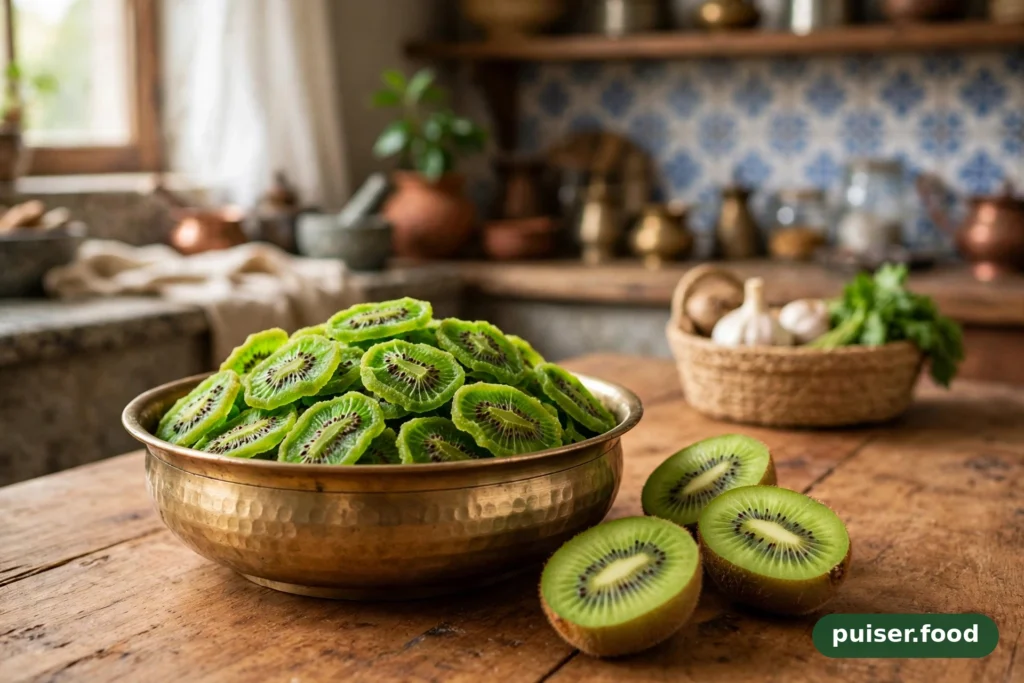
Dried kiwi is the bright green slice of the Indian dry fruit shelf, the sweet and tangy round that turns up in trail mix, smoothies and salads. It tastes like a sweet and carries the sugar to match, so the question is whether it earns its place as a health food or only as a sweet. This guide covers the dried kiwi benefits that matter most, the fibre and potassium numbers told honestly, the sugar-coated trap, and the five best dishes.
In this article
- The short answer
- What dried kiwi actually is
- Dried kiwi in numbers
- 10 benefits worth knowing
- The sugar-coated story, honestly
- Unsweetened versus sugar-coated versus freeze-dried
- Five everyday ways to use it
- Buying and storing dried kiwi
- 5 expert tips
- Common mistakes to avoid
- Frequently asked questions
- Conclusion
The Short Answer
The dried kiwi benefits that matter most are fibre and potassium, in a dried fruit that needs no cooking at all. A 100 g portion of unsweetened dried kiwi gives about 7 to 10 g of fibre and about 600 to 900 mg of potassium for about 250 to 320 kcal, and a small 30 g handful gives about 86 kcal and 2.6 g of fibre. Dried kiwi is sugar dense, about 40 to 50 g of sugars per 100 g unsweetened and more in sugar-coated packs, so a small handful a day is the portion.
What Dried Kiwi Actually Is
Dried kiwi is slices of green kiwifruit, Actinidia deliciosa, dried in hot air or freeze-dried until they turn bright green, chewy and sweet and tangy. India grows kiwi in Arunachal Pradesh, Himachal and Uttarakhand, yet most dried kiwi on the shelf is made from imported fruit, and the slices hold a growing place in Indian kitchens, in trail mixes, smoothies, salads and children’s tiffins.
That dried kiwi carries fibre and potassium with its sugar is the first thing to understand, because it is what separates a kiwi slice from a sweet, and it is where the dried kiwi benefits start. A kiwi slice gives natural sugars with fibre, potassium and vitamin C attached. The fibre slows digestion a little, and the fruit still tastes like a sweet, so dried kiwi works as a snack and a garnish at once.
Dried kiwi is also the fruit of the trail mix and the smoothie glass, in the salad of a summer lunch, in the oats of a winter morning and in the tiffin of a school day. Our dried mango benefits guide covers the other golden dried fruit of the same shelf, for aam rather than kiwi. Our dried pineapple benefits guide covers the tropical ring with the most sugar of the series, and our dried apples benefits guide covers the chewy ring with the most fibre of the dried fruit shelf.

Dried Kiwi in Numbers
The table below sets out the dried kiwi benefits in numbers, and it uses ranges throughout, because dried kiwi figures vary by drying method and sweetening. The figures are from published nutrition tables for unsweetened dried kiwi, per 100 g, checked against a freeze-dried specification and against fresh kiwi from USDA FoodData Central.
| Nutrient (per 100 g, unsweetened) | Amount |
|---|---|
| Energy | 250 to 320 kcal |
| Protein | 3 to 4 g |
| Fat | 0 to 1 g |
| Carbohydrates | 64 to 75 g |
| Fibre | 7 to 10 g |
| Sugars | 40 to 50 g |
| Sodium | about 10 mg |
| Calcium | 70 to 87 mg |
| Iron | 1 to 1.5 mg |
| Potassium | 600 to 900 mg |
| Vitamin C | 15 to 60 mg |
| Vitamin K | about 40 mcg |
The portion table below turns those 100 g figures into handfuls people actually eat, using the midpoints of the ranges above. A 30 g handful is about six slices, and it is the portion this guide uses everywhere.
| Portion (unsweetened, about) | Energy | Fibre | Sugars | Potassium |
|---|---|---|---|---|
| 30 g handful (about 6 slices) | 86 kcal | 2.6 g | 14 g | 225 mg |
| 50 g, about 10 slices | 143 kcal | 4.3 g | 23 g | 375 mg |
| 100 g | 250 to 320 kcal | 7 to 10 g | 40 to 50 g | 600 to 900 mg |
The comparison table below puts the two dried forms beside fresh kiwi, on the four numbers that matter most. Unsweetened dried kiwi carries the most fibre and potassium of the three, while sugar-coated kiwi carries more sugar and less fibre, and fresh kiwi carries the least of everything because it is mostly water, but it keeps the most vitamin C.
| Per 100 g | Unsweetened dried kiwi | Sugar-coated dried kiwi | Fresh green kiwi |
|---|---|---|---|
| Energy | 250 to 320 kcal | 300 to 350 kcal | 61 kcal |
| Fibre | 7 to 10 g | 5 to 8 g | 3 g |
| Sugars | 40 to 50 g | 50 to 60 g | 9 g |
| Vitamin C | 15 to 60 mg | 10 to 40 mg | about 90 mg |
10 Benefits Worth Knowing
Here are the ten dried kiwi benefits worth knowing, in the order a home cook would care about them. Each one is tied to a number from the tables above or to a study named in the text.
1. Fibre that actually counts
The first of the dried kiwi benefits is the fibre, 7 to 10 g per 100 g in the unsweetened fruit, which is more than raisins at 3.7 g and double cranberries at 5.3 g. A 30 g handful gives 2.6 g of fibre, a useful share of the daily target in a food that needs no cooking, and the fibre slows the sugars down a little and keeps a small handful filling for longer than a sweet of the same size.
2. Potassium for a healthy diet
The second of the dried kiwi benefits is the potassium, 600 to 900 mg per 100 g, which is far more than cranberries at 49 mg and about the same as raisins at 749 mg. A 30 g handful gives about 225 mg of potassium, a useful share in a food that needs no cooking, and potassium helps the body balance fluids and supports healthy blood pressure as part of a whole diet.
3. Vitamin C, if the drying is kind
Fresh kiwi carries about 90 mg of vitamin C per 100 g, one of the highest of any common fruit, and dried kiwi keeps some of it, 15 to 60 mg in hot-air dried slices and most of it in freeze-dried slices. A 30 g handful of freeze-dried kiwi can give about as much vitamin C as a fresh orange, while the same handful of hot-air dried kiwi gives far less. Buy freeze-dried slices for vitamin C, and eat a fresh kiwi too.
4. Actinidin, the protein helper
Kiwi is one of the few fruits that carries its own protein-digesting enzyme, actinidin, which helps break down protein in the gut, and it is the reason kiwi is used as a meat tenderiser in some kitchens. Drying keeps some of the actinidin, though heat cuts it. The effect is small and the evidence is mostly from the fresh fruit, so dried kiwi is a pleasant digestive aid, not a medicine for digestion.
5. Lutein and zeaxanthin for the eyes
Fresh kiwi carries about 120 mcg of lutein and zeaxanthin per 100 g, the yellow pigments that sit in the retina and filter blue light, and drying concentrates them with everything else in the fruit. A 30 g handful of dried kiwi gives a useful share of the day’s lutein, though no trial has tested dried kiwi on eye health, and the amounts are small beside a plate of spinach or methi.
6. The sleep story, kept honest
The sleep story is the most famous kiwi claim, and it rests on one small study. In 2011, researchers at Taipei Medical University asked 24 adults with sleep problems to eat two green kiwis one hour before bed every night for four weeks, and the group fell asleep about 35 percent faster and slept about 13 percent longer. The study had no control group, and it tested fresh kiwi, not dried slices. Dried kiwi carries the same serotonin and folate that researchers point to, but the sleep claim belongs to fresh kiwi, and a dried slice is a snack, not a sleeping pill.
7. Vitamin K in a fruit
Dried kiwi carries about 40 mcg of vitamin K per 100 g, which is more than most dried fruits in this series and about a third of the day’s need. A 30 g handful gives about 12 mcg, a small share of the day, and vitamin K helps the blood clot and supports bone health as part of a whole diet.
8. Iron and calcium in small amounts
Dried kiwi carries about 1 to 1.5 mg of iron and 70 to 87 mg of calcium per 100 g, which is more than dried apples at 1.4 mg of iron and 14 mg of calcium. A 30 g handful gives about 0.4 mg of iron and 24 mg of calcium, small shares of the day, and the iron is the plant kind, which the body absorbs poorly on its own.
9. A snack that travels well
Dried kiwi keeps for about six months in an airtight jar without a fridge, and it is light, tough and hard to crush, which makes it one of the best dried fruits for a train journey, a trek or a school tiffin. Fresh kiwi is heavy, soft and bruises easily, while the dried slices weigh almost nothing and keep their shape in a bag. The green slices need only a dry jar to stay good.
10. A small handful that satisfies a sweet craving
A 30 g handful gives about 86 kcal and 2.6 g of fibre, and the chew and the sweet tang satisfy a sweet craving for longer than a biscuit of the same calories. The fibre slows the eating down, the sweetness is real, and the portion is easy to measure, about six slices in a small bowl, so the craving ends without the pack emptying.

The Sugar-Coated Story, Honestly
Most dried kiwi on the Indian shelf is sugar-coated, which means the slices were soaked in sugar syrup before drying, and the syrup pushes the sugars to 50 to 60 g per 100 g and the calories to 300 to 350, while the fibre falls to 5 to 8 g. Unsweetened dried kiwi carries 40 to 50 g of sugars, all of them the fruit’s own, and no added sugar at all. The difference is the syrup, and the label tells the story: if sugar or glucose syrup comes before kiwi in the ingredients, portion it like a dessert.
Sulphur dioxide keeps the slices bright green, and it is used on most sugar-coated packs, so sensitive buyers, especially people with asthma, should pick unsulphured slices, which look duller but taste the same. Some packs also carry artificial colours, yellow and blue food dyes, to keep the green bright, and a pack that lists them is a coloured sweet rather than a dried fruit. The plainest pack, with kiwi and nothing else on the ingredients list, is the best buy.
Unsweetened dried kiwi is a fibre and potassium food with a real sugar cost, and sugar-coated dried kiwi is closer to a sweet with a health halo. Buy the unsweetened kind for fibre and potassium, buy the sugar-coated kind only as a dessert topping, and weigh the portion either way, because a handful of either disappears in a few bites.

Unsweetened Versus Sugar-Coated Versus Freeze-Dried
The benefits do not change much between green and gold kiwi slices, because the fruit is similar, but they change a lot between unsweetened and sugar-coated packs. Unsweetened slices are tangy, chewy and keep 7 to 10 g of fibre per 100 g, while sugar-coated slices are sweeter, softer and carry 50 to 60 g of sugars. Freeze-dried slices are light, crisp and keep most of their vitamin C, because freeze-drying uses cold instead of heat, but they cost far more and crush easily, so they suit a smoothie or a garnish better than a trail mix.
Gold kiwi slices sit in the middle. Gold kiwifruit is sweeter and lower in fibre than green, but higher in vitamin C, and the dried gold slices taste milder and less tangy. The variety matters less than the label: sugar listed first means candied, and a single ingredient line means plain. A medium fresh kiwi gives about 61 kcal with about 90 mg of vitamin C and 3 g of fibre, so the fresh fruit wins on vitamin C and hydration, while the dried slice wins on fibre and potassium per gram.
Kiwi allergy deserves one line here. Some people react to kiwi with an itchy mouth or lips, the oral allergy pattern, and kiwi cross-reacts with latex, so people with a latex allergy should be careful with kiwi in any form. Drying does not reliably destroy the proteins that cause the reaction, so a person who reacts to fresh kiwi should avoid the dried slices too. The dried kiwi benefits are real, but only for the eater who can eat kiwi safely, so the allergy line matters more than any number in this guide.
Five Everyday Ways to Use It
The dried kiwi benefits show up best in five everyday dishes, each one using a small handful rather than a bowlful, with the kiwi at 30 g or less.
1. Trail mix with almonds and walnuts
Mix 30 g of dried kiwi slices, torn small, with a handful of almonds and walnuts and a spoon of pumpkin seeds, and the mix travels well in a small box for a train journey or a desk. The kiwi gives the chew and the sweet tang, the nuts give the crunch and the fats, so the mix feels like a dessert and eats like a snack. Our walnuts benefits guide covers the nut that makes this snack filling rather than just sweet.
2. Kiwi smoothie with curd
Blend a frozen banana with a cup of curd and 30 g of dried kiwi slices, pour into a glass, and top with chia seeds and a few more kiwi pieces. The kiwi gives the colour and the tang, the curd gives the protein, and the chia gives the crunch. Soak the dried slices in warm water for ten minutes first, so they soften before blending.
3. Curd bowl with honey
Spoon 30 g of dried kiwi slices over a bowl of thick curd with a teaspoon of honey and a few chopped almonds, and the curd gives the protein, the kiwi gives the sweetness and the chew, and the almonds give the crunch. The bowl works as a light lunch or an evening snack, and the curd and nuts slow the sugars down so the snack stays filling for longer.
4. Green salad with paneer and walnuts
Toss 30 g of dried kiwi slices into a salad of greens, cucumber, crumbled paneer and chopped walnuts, with a lemon and olive oil dressing, and the kiwi gives the salad a sweet tang against the salt of the paneer and the bite of the walnuts. The fruit works in a salad the way raisins do, as a small sweet contrast.
5. Oats porridge with cinnamon
Stir 30 g of dried kiwi slices, chopped small, into a bowl of oats cooked in milk, with a pinch of cinnamon and no extra sugar, and the kiwi softens in the heat and turns the oats sweet and fragrant. The fibre of the oats and the fibre of the kiwi work together, and the bowl needs no jaggery or honey, because the kiwi carries the sweetness.

Buying and Storing Dried Kiwi
The dried kiwi benefits survive or die on the label, so buy by the label, not by the price alone. The ingredients list should read kiwi, and a pack that lists sugar first is a candied sweet rather than a dried fruit. Bright green slices are usually sulphured, so pick dull if asthma or a sulphite sensitivity is a concern. The market range for a 250 g pack runs from about ₹153 to about ₹299, so a pack at ₹245 sits in the honest middle.
Store dried kiwi in an airtight jar in a cool, dark place, where it keeps for about six months, or in the fridge, where it keeps for about a year. Its sugars attract moisture, so a pack left open in a humid kitchen will turn sticky and clump. Throw the slices away if they smell sour, taste fermented or show mould. A 250 g pack at ₹245 works out to about ₹29 for a 30 g handful, less than a cutting chai.
5 Expert Tips
1. Read the ingredients before the price. Read the ingredients list before looking at the price, because a pack that lists sugar first is a candied sweet, and the cheapest pack is usually the sweetest.
2. Soak before blending. Soak dried kiwi slices in warm water for ten minutes before blending them into a smoothie, so they soften instead of staying in chewy pieces.
3. Pair with curd for protein. Eat dried kiwi with curd or nuts rather than alone, because the protein and fat slow the sugars down and keep the snack filling for longer.
4. Buy dull for sensitive eaters. Buy dull unsulphured slices for children and for anyone with asthma, because sulphites can trouble sensitive eaters and the colour makes no difference to the taste.
5. Measure the handful. Measure about six slices into a small bowl and put the pack away, because a handful eaten from the pack is usually two, and the sugar adds up fast.
Common Mistakes to Avoid
Eating by the bowlful. The commonest mistake is treating dried kiwi like fresh kiwi and eating a whole bowl, about 100 g and 40 to 50 g of sugars. A small handful is the portion.
Buying sugar-coated as plain. Most dried kiwi on the Indian shelf is sugar-coated, with sugar listed first in the ingredients. Check the label, and if sugar comes first, put the pack back.
Expecting a vitamin C food. Hot-air dried kiwi keeps only 15 to 60 mg of vitamin C per 100 g, far less than the fresh fruit, because heat drying cuts it. Eat dried kiwi for fibre and potassium, and eat a fresh kiwi for vitamin C.
Storing in the open pack. A pack left open in a humid kitchen turns sticky, clumps and can ferment. Move the slices to an airtight jar on the day the pack is opened.
Ignoring the allergy. Kiwi can trigger an itchy mouth in people with oral allergy, and it cross-reacts with latex. Drying does not remove the risk, so a person who reacts to fresh kiwi should avoid the dried slices too.
Frequently Asked Questions
What are the main dried kiwi benefits?
Dried kiwi benefits centre on fibre and potassium, with 7 to 10 g of fibre and 600 to 900 mg of potassium per 100 g of unsweetened slices, plus vitamin C, vitamin K, actinidin and lutein in smaller amounts. The benefits belong to the unsweetened kind. Sugar-coated slices carry more sugar and less fibre, so the label check matters.
Is dried kiwi good for weight loss?
A small handful of dried kiwi, about 30 g and 86 kcal, suits a weight loss diet better than a biscuit of the same calories, because the fibre makes it filling. The catch is the portion. Dried kiwi is sugar dense and the calories add up fast from the pack, so it works only when the handful is measured.
Is dried kiwi good for diabetes?
Dried kiwi is sugar dense, about 40 to 50 g of sugars per 100 g unsweetened and 50 to 60 g in sugar-coated packs, so a small handful affects blood sugar. The fibre slows the sugars down a little, but the portion must stay small. People with diabetes should count it as the sweet of the meal.
Does dried kiwi help with sleep?
The sleep study was on fresh kiwi, not dried slices, and it was small, with 24 adults and no control group, so the honest answer is maybe. Two fresh kiwis before bed helped the group fall asleep about 35 percent faster, but dried kiwi has not been tested, and it is a snack, not a sleeping pill.
Is dried kiwi good for digestion?
Kiwi carries actinidin, an enzyme that helps break down protein, and the fibre supports a healthy gut, so dried kiwi helps digestion a little. The evidence is mostly from the fresh fruit, and heat drying cuts the enzyme, so the dried slice is a pleasant aid rather than a medicine for digestion.
How much dried kiwi can I eat in a day?
A small handful of about 30 g, about six slices, is the daily portion this guide uses, with about 86 kcal and 2.6 g of fibre. Eating more is fine on some days, but a whole 100 g pack carries 40 to 50 g of sugars, so measure the handful rather than eating from the pack.
Is dried kiwi good for the eyes?
Fresh kiwi carries about 120 mcg of lutein and zeaxanthin per 100 g, the pigments that sit in the retina, and drying concentrates them, so dried kiwi gives a useful share. No trial has tested dried kiwi on eye health, so the pigments are a bonus in a fruit bought for fibre.
Is dried kiwi good for pregnancy?
Dried kiwi gives fibre, potassium and folate in small amounts, and a small handful fits a healthy pregnancy diet. The caution is the sugar-coated kind, which adds a lot of sugar for little benefit, and a sulphite sensitivity. Ask your own doctor about portions, and buy the plain unsweetened kind.
Can children eat dried kiwi?
Children can eat dried kiwi in small handfuls, and the sweet tang makes it an easy tiffin fruit. Buy the unsulphured unsweetened kind for children, and watch for kiwi allergy, which shows up as an itchy mouth or lips, especially in children with a latex allergy.
Does dried kiwi have side effects?
The main side effects are sugar and sulphites. Sugar-coated dried kiwi carries 50 to 60 g of sugars per 100 g, and sulphured slices carry sulphur dioxide, which can trouble people with asthma. Kiwi allergy, with an itchy mouth or lips and a latex cross-reaction, is the other caution.
Conclusion
Dried kiwi earns its place in the trail mix when the slices are plain and the portion is a handful. The dried kiwi benefits, fibre and potassium and a little vitamin C, make it a better sweet than a biscuit, and the green slices travel well, keep for months and turn a curd bowl or a salad into a small treat. The trap is the sugar-coated pack, and the fix is a label check. Try a small handful in a trail mix, in a smoothie or over curd, and see where it earns its place in your kitchen.
Disclaimer: This article is for general information only and is not medical advice. If you have diabetes, kidney disease, a kiwi or latex allergy, or you take warfarin, talk to your doctor before making dried kiwi a daily habit.