Introduction
Sunflower seeds sit in almost every Indian kirana store, usually in a plain packet near the roasted chana, and most kitchens walk straight past them. That is a mistake. A single seed carries more vitamin E per 100 g than any other commonly eaten food, plus a rare combination of selenium, iron, zinc and magnesium in one small handful. This guide covers the sunflower seeds benefits that matter most, the vitamin E story behind them, the honest omega-6 question, and five everyday ways to eat them.
In this article
- The short answer
- What sunflower seeds actually are
- Sunflower seeds in numbers
- 10 benefits worth knowing
- Vitamin E: the headline nutrient
- Selenium: the quiet second act
- Heart health and the omega-6 question
- Skin, hair and the vitamin E claim
- How to eat sunflower seeds
- Five everyday ways to use them
- Buying and storing sunflower seeds
- 5 expert tips
- Common mistakes to avoid
- Frequently asked questions
- Conclusion
The Short Answer
The sunflower seeds benefits that matter most are the vitamin E and the minerals. A 30 g handful, about two tablespoons, gives roughly 10.6 mg of vitamin E, about 70% of the daily value, plus about 16 mcg of selenium, 1.6 mg of iron and 1.5 mg of zinc. The seeds are calorie dense, 584 kcal per 100 g, so the portion is a handful, not a bowl. They are rich in omega-6 fats, which is a real consideration, and the salted roasted kind can carry a lot of sodium. What they are is the cheapest vitamin E in the Indian kitchen, in a seed that needs no recipe.
What Sunflower Seeds Actually Are
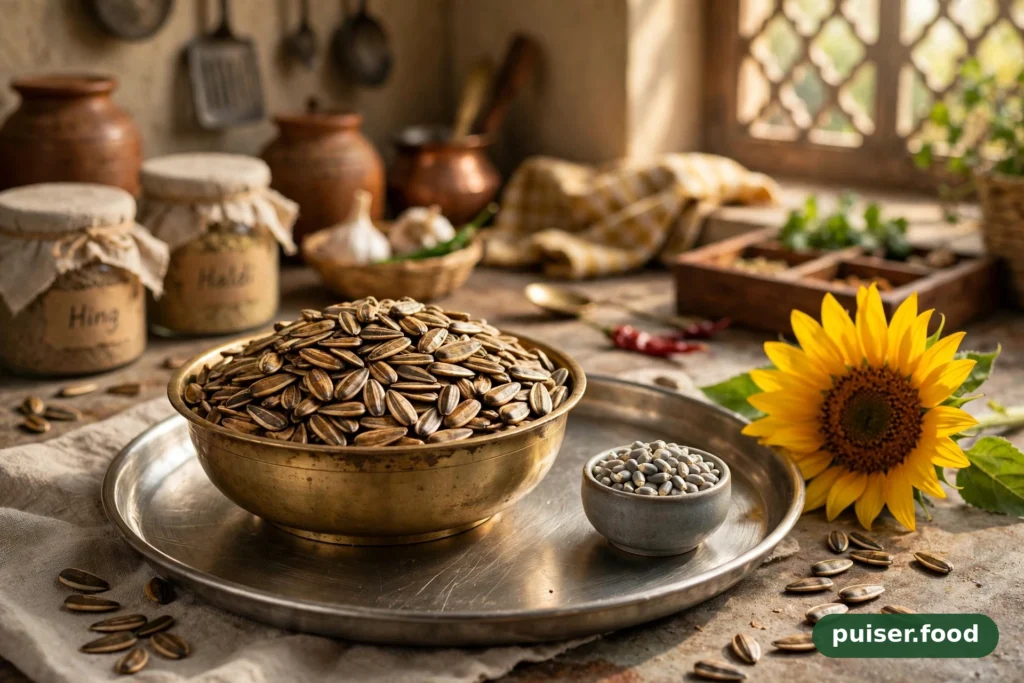
Sunflower seeds are the seeds of the sunflower, Helianthus annuus, a plant native to North America that is now grown across Karnataka, Andhra Pradesh, Maharashtra and Tamil Nadu, mostly for its oil. The seed inside the striped black and white shell is a soft grey kernel with a mild, nutty taste. The nutrition figures in this guide are for the dried kernels, the part you eat, not for the shell.
That distinction matters. The shell is mostly fibre and adds bulk with little nutrition, and most people spit it out. The kernel is the concentrated part, with 20.8 g of protein and 35.17 mg of vitamin E per 100 g, according to the USDA record for dried kernels. A spoonful of kernels is a very different food from a handful of shell-on seeds you crack between your teeth.
The seeds are also one of the easiest foods to add to an Indian kitchen, because they need no recipe and no cooking skill. They roast in a few minutes in a kadhai, keep for months in a jar, and go on top of almost anything. Our pumpkin seeds benefits guide covers the other seed that belongs in the same jar, the magnesium seed to this one’s vitamin E.
Sunflower Seeds in Numbers
The table below sets out the sunflower seeds benefits in numbers, comparing dried sunflower seed kernels with pumpkin seeds, flaxseed and chia seeds per 100 g, using the USDA FoodData Central records. The gap that matters most is vitamin E, where sunflower seeds lead by an enormous margin, and the gap that matters least is fibre, where chia and flax leave them far behind. Protein is solid at 20.8 g, and selenium is the other surprise, at 53 mcg per 100 g.
| Nutrient (per 100 g, dried) | Sunflower seeds | Pumpkin seeds | Flaxseed | Chia seeds |
|---|---|---|---|---|
| Energy | 584 kcal | 559 kcal | 534 kcal | 486 kcal |
| Protein | 20.8 g | 30.2 g | 18.3 g | 16.5 g |
| Fat | 51.5 g | 49.1 g | 42.2 g | 30.7 g |
| Fibre | 8.6 g | 6.0 g | 27.3 g | 34.4 g |
| Vitamin E | 35.17 mg | 2.2 mg | 0.31 mg | 0.25 mg |
| Selenium | 53 mcg | 9.4 mcg | 25.4 mcg | 34.4 mcg |
| Magnesium | 325 mg | 592 mg | 392 mg | 335 mg |
| Iron | 5.25 mg | 8.82 mg | 5.73 mg | 7.72 mg |
| Zinc | 5.0 mg | 7.81 mg | 4.34 mg | 4.58 mg |
| Folate | 227 mcg | 58 mcg | 87 mcg | 63 mcg |
Figures per USDA FoodData Central: sunflower seed kernels, dried (FDC 170562); pumpkin and squash seed kernels, dried (FDC 170556); flaxseed (FDC 169414); chia seeds, dried (FDC 170554). Vitamin E is alpha-tocopherol throughout.
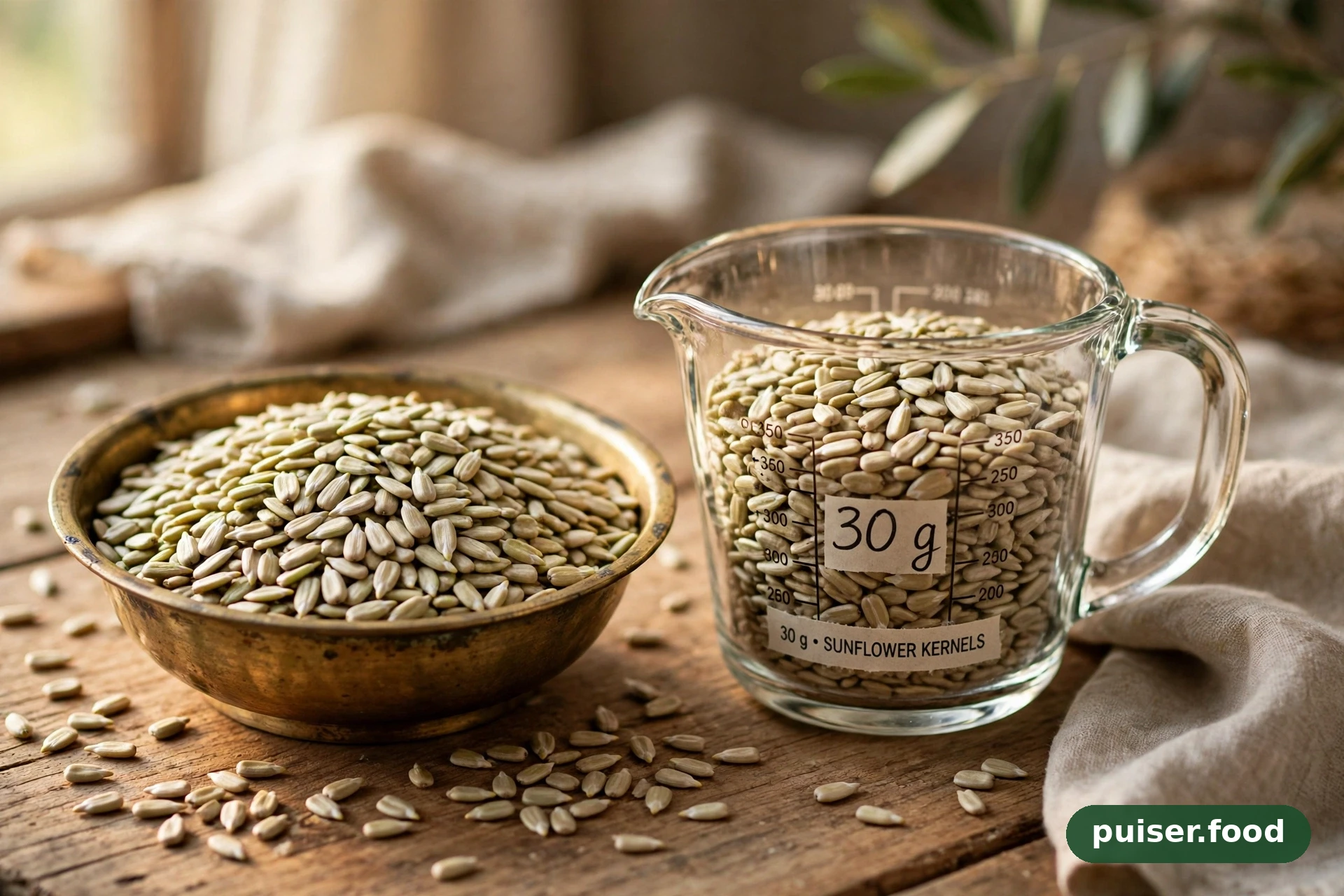
The second table shows what a daily handful actually gives you. A 30 g portion is about two tablespoons, or a small katori, and it is the portion this guide uses everywhere. The percentages use the US daily values, because the USDA record reports against them.
| Nutrient | Per 30 g handful | Share of daily value |
|---|---|---|
| Energy | 175 kcal | About 9% |
| Protein | 6.2 g | About 12% |
| Vitamin E | 10.6 mg | About 70% |
| Selenium | 15.9 mcg | About 29% |
| Magnesium | 97.5 mg | About 23% |
| Iron | 1.6 mg | About 9% |
| Zinc | 1.5 mg | About 14% |
| Folate | 68 mcg | About 17% |
| Fibre | 2.6 g | About 9% |
Roasting changes the picture, and the third table shows how. Dry roasting cuts vitamin E by about a quarter, from 35.17 mg to 26.1 mg per 100 g, and salted roasted seeds carry 655 mg of sodium per 100 g, or about 186 mg per ounce. The calories barely move. So the plain dried or lightly dry-roasted kernel is the better buy, and the salted kind is a snack, not a supplement.
| Form (per 100 g) | Energy | Vitamin E | Sodium |
|---|---|---|---|
| Dried kernels | 584 kcal | 35.17 mg | Very low |
| Dry roasted, no salt | About 582 kcal | 26.1 mg | Very low |
| Dry roasted, with salt | About 582 kcal | 26.1 mg | 655 mg |
| Oil roasted, no salt | 592 kcal | About 36.3 mg | Very low |
Figures per USDA FoodData Central SR Legacy records for sunflower seed kernels, dried (FDC 170562) and dry roasted with salt added. Oil roasted figures vary by the oil used and the record, so treat them as approximate.
10 Benefits Worth Knowing
These are the ten sunflower seeds benefits worth knowing, in the order that matters for an Indian kitchen. The first three are the nutrition facts. The rest are what those facts mean in practice, including the honest limits.
1. Vitamin E in a quantity no other common food matches
A 100 g portion carries 35.17 mg of vitamin E, about 234% of the daily value, and a 30 g handful still gives about 70%. Almonds, the next best known source, carry about 26 mg per 100 g. Vitamin E is a fat soluble antioxidant that protects cell membranes from damage by free radicals, and it supports normal immune function.
2. Selenium for the antioxidant system
At 53 mcg per 100 g, a handful gives about 29% of the daily value of selenium. Selenium powers the glutathione peroxidase enzymes, part of the body’s own antioxidant defence, and it supports normal thyroid function.
3. Plant protein without meat or dairy
With 20.8 g of protein per 100 g, a handful gives about 6.2 g, roughly the protein of one egg white. The protein is not complete on its own, so it works best alongside dal, curd or grains, which is exactly how Indian meals are built.
4. Magnesium for muscles, nerves and energy
A handful gives about 97.5 mg of magnesium, about 23% of the daily value. Magnesium is involved in muscle and nerve function, energy production and protein synthesis. Indian diets are frequently short of it, and the seed is an easy top-up. Pumpkin seeds carry more, at 592 mg per 100 g, so the two seeds complement each other in the same jar.
5. Iron and zinc together
The seeds carry 5.25 mg of iron and 5.0 mg of zinc per 100 g, giving about 1.6 mg of iron and 1.5 mg of zinc per handful. Plant iron absorbs poorly on its own, so it counts for more with vitamin C in the meal, a squeeze of lemon on the poha or a tomato sabzi alongside. Our amla benefits guide explains why amla is the best vitamin C partner for plant iron. Zinc supports normal immune function and skin health.
6. Folate for everyday cell repair
At 227 mcg per 100 g, sunflower seeds are one of the better seed sources of folate, giving about 68 mcg per handful. Folate is needed to make new cells, which is why it matters in pregnancy and in growing children. It is not a reason to eat the seeds instead of green leafy vegetables, which carry far more, but it is a useful addition to a folate-short diet.
7. Fibre that helps you feel full
The kernels carry 8.6 g of fibre per 100 g, about 2.6 g per handful. That is far less than chia at 34.4 g or flax at 27.3 g, so fibre is not the reason to choose this seed. But it is enough, with the protein and fat, to make a small handful a satisfying snack that keeps hunger away for a couple of hours.
8. Healthy unsaturated fats
Most of the 51.5 g of fat per 100 g is unsaturated, largely linoleic acid, an essential omega-6 fatty acid the body cannot make. Unsaturated fats in place of saturated fats support heart health, which is the standard dietary advice. The catch is the balance with omega-3, covered honestly in the heart section below.
9. Copper and manganese in small but real amounts
A 100 g portion carries about 1.8 mg of copper and about 2 mg of manganese, both well over the daily value. Copper helps the body use iron and form connective tissue, and manganese supports bone formation and the enzymes that handle carbohydrates.
10. A snack that needs no cooking and no fridge
The practical benefit is the simplest one. The seeds keep for months in an airtight jar, travel well in a dabba, and need no fridge, no soaking and no cooking. For school tiffins, office desks and train journeys, a small pouch of roasted kernels is a snack with real nutrition behind it, at a few rupees a portion.
Vitamin E: The Headline Nutrient
That single number is the first of the sunflower seeds benefits, and it deserves a closer look, because vitamin E is the nutrient this seed owns. At 35.17 mg per 100 g, sunflower kernels carry more vitamin E than almonds at about 26 mg, more than groundnuts, and far more than any dal or grain. A 30 g handful gives 10.6 mg, which is about 70% of the US daily value of 15 mg. In practice, one handful a day covers the vitamin E base for most adults, even before the rest of the diet is counted.
Vitamin E is a fat soluble antioxidant, which means it dissolves in fat and sits in cell membranes, protecting them from the damage caused by free radicals. It also supports normal immune function. The body stores it, so a daily handful builds a reserve rather than washing out the same day.
Roasting is the one thing that eats into the vitamin E. Dry roasting drops it from 35.17 mg to 26.1 mg per 100 g, a loss of about a quarter, because heat and air oxidise the vitamin. Light roasting in a kadhai for a few minutes costs less than long roasting in a hot oven. Eating the kernels raw keeps the full amount, but raw seeds carry more phytic acid, which binds some minerals. The practical compromise is a light dry roast, just until they smell nutty, and no salt until after roasting.
One caution belongs here. Vitamin E from food is safe at these levels, but high dose vitamin E supplements are a different matter and have been linked to problems in trials. The seeds are food, not a supplement, and a 30 g portion stays well inside the normal dietary range.
Selenium: The Quiet Second Act
Selenium is the second of the sunflower seeds benefits that sets this seed apart, and it is quieter because few people track it. At 53 mcg per 100 g, sunflower kernels carry more selenium than pumpkin seeds at 9.4 mcg, more than flax at 25.4 mcg and more than chia at 34.4 mcg. A handful gives about 16 mcg, close to a third of the daily value. Only Brazil nuts carry far more, and they are expensive and easy to overeat.
Selenium is part of the glutathione peroxidase enzymes, which are one of the body’s own antioxidant defences, and it supports normal thyroid function. The thyroid link is the one that gets overstated in blogs, so keep it plain: selenium is necessary for normal thyroid hormone metabolism, and a deficiency can impair it, but eating sunflower seeds is not a thyroid treatment, and thyroid disease needs a doctor.
The honest caveat is that selenium in food depends on the soil it grew in, so the 53 mcg figure is a USDA average, not a guarantee for every packet. Indian soils vary, and no Indian study gives a reliable figure for Indian grown sunflower kernels. The seed is still a good bet for selenium, but the number should be read as approximate, not exact.
Heart Health and the Omega-6 Question
The heart story is where the sunflower seeds benefits need the most honesty, because the fat that makes the seed healthy is also the fat that needs balance. The seeds are rich in linoleic acid, an essential omega-6 fatty acid, and replacing saturated fat with unsaturated fat supports heart health. Several observational studies link higher vitamin E intake from food with better heart outcomes, and the seeds also carry magnesium, folate and fibre, which all sit on the heart friendly side of the evidence.
But the Indian diet is already heavy on omega-6. Sunflower oil, groundnut oil and soybean oil are all rich in it, and most households cook with them daily. Adding a large daily portion of sunflower seeds on top of that pushes the omega-6 to omega-3 ratio further in the wrong direction, and the seeds carry almost no omega-3 to balance it. That is why the portion is 30 g, not 100 g, and why the seeds should sit alongside omega-3 foods rather than replacing them. Our flaxseed benefits guide and chia seeds benefits guide cover the two seeds that actually supply omega-3.
Skin, Hair and the Vitamin E Claim
Vitamin E is sold in skin creams for a reason, and the jump from cream to food is where blogs usually overreach. The honest version is this: vitamin E protects cell membranes, including skin cells, from oxidative damage, and a diet short of it can show up in dull skin. A daily handful covers the dietary base, which is the honest claim. There is no good evidence that eating sunflower seeds clears acne, grows hair or reverses wrinkles, and hair fall has many causes that seeds cannot fix.
What the seeds do give the skin is the combination, vitamin E plus zinc plus selenium plus healthy fats, all of which the skin uses. That is a real, ordinary benefit, the kind that shows up over months of eating well rather than in a week of snacking. Keep the claim at that size and it stays true.
How to Eat Sunflower Seeds
Getting the sunflower seeds benefits is mostly a matter of portion and preparation, and both are simple. The portion is 30 g a day, about two tablespoons or a small katori. The preparation is a light dry roast in a kadhai for three to four minutes, shaking the pan, just until the kernels smell nutty and turn a shade darker. Let them cool, then store them in an airtight jar. Add salt only after roasting, and lightly, because salt added before roasting draws moisture and makes the seeds steam instead of roast.
Raw kernels are fine too, and they keep the full vitamin E. Soaking overnight and then drying is another option, which reduces phytic acid and improves mineral absorption, but it is more work than most households need. For most people, the light roast is the right balance: better flavour, better mineral absorption, and a small vitamin E loss that a daily handful still covers.
Shell-on seeds are a different experience. They are cheaper, they keep longer, and cracking them slows you down, which helps with portion control. But they are messy, and the shells are a choking risk for small children. For cooking and sprinkling, buy the kernels. For an evening snack in front of the television, the shell-on kind is fine.
Five Everyday Ways to Use Them
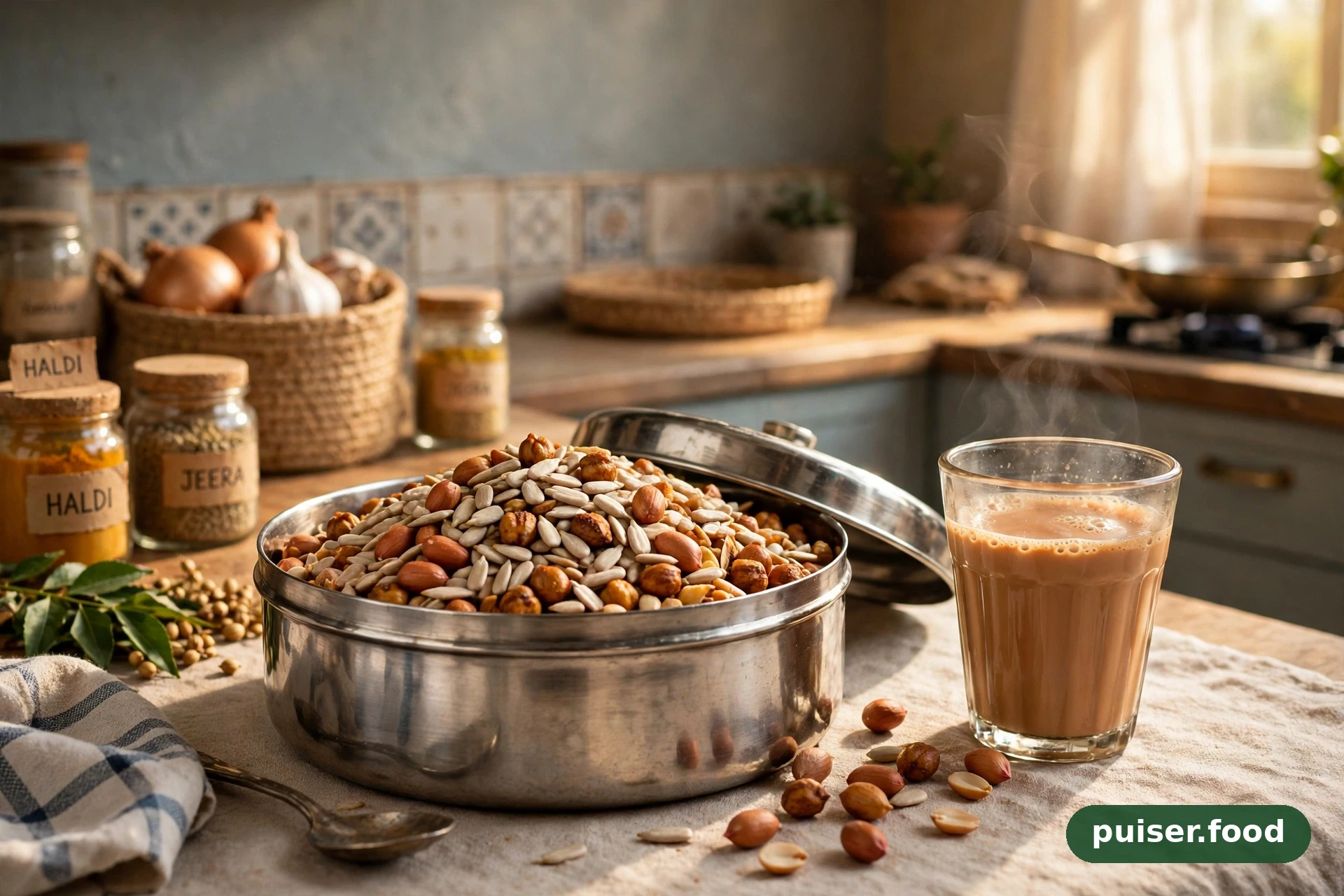
The seeds fit into food you already cook, and that is the point. No new recipe is needed. First, roast a batch on Sunday and keep the jar on the counter, then scatter a spoonful on poha, upma or curd rice at breakfast. Second, mix them into a trail mix with roasted chana, peanuts and a few raisins for a school tiffin or an office drawer. Third, blend them into chutney, replacing half the groundnuts with sunflower kernels for a nuttier taste and more vitamin E. Fourth, sprinkle them on dal, salads and sabzi just before serving, so they stay crunchy. Fifth, fold them into laddoo, chikki or energy balls with jaggery and sesame, where they add crunch and keep well for weeks.
They also work in baking, on top of breads and buns, and in smoothies, where a tablespoon blends in without changing the taste much. What they do not do well is replace a main ingredient. They are a topping and a snack, not a dal, and a handful is the measure. Our chia seeds benefits guide covers the seed that belongs in the same trail mix for fibre and omega-3.
Buying and Storing Sunflower Seeds
The sunflower seeds benefits survive or die on how the seeds were stored and roasted, so buy with your eyes open. Buy the plain kernels, not the salted roasted kind, unless you want a snack rather than a daily food. The kernels should be grey and plump, with no black spots and no musty smell. A stale kernel tastes bitter and flat, and no amount of roasting fixes it. Check the pack date, and prefer a shop that turns its stock over quickly, because old seeds go rancid faster than most people expect.
Price is reasonable. Certified organic sunflower seeds sell for about 140 to 200 rupees per 250 g in India, with ordinary kernels cheaper. A 250 g pack lasts about eight days at a 30 g portion, so the cost is roughly 5 to 7 rupees a day. Buy small packs often rather than a kilo that sits in the cupboard for months.
Store the kernels in an airtight jar in a cool, dark place for about three months, or in the fridge for about six months. Ground seeds go stale fastest, in about two weeks, so grind only what you need for the day. Throw away any batch that smells musty, tastes bitter or looks damp.

5 Expert Tips
These five habits protect the sunflower seeds benefits and keep the jar worth reaching for. First, roast lightly and briefly, because long hot roasting burns off a quarter of the vitamin E. Second, buy plain kernels and salt them yourself, lightly, after roasting. Third, keep the portion at 30 g, measured once with a tablespoon so your eye learns the amount. Fourth, pair the seeds with an omega-3 food most days, a spoonful of ground flaxseed or soaked chia, to balance the omega-6. Fifth, store them in the fridge in summer, because the high fat content turns rancid fast in Indian heat.
Common Mistakes to Avoid
The most common mistake is the portion. A 100 g packet of roasted kernels is easy to finish while watching television, and that is 584 kcal with no meal attached. Measure the handful, or keep a small dabba of 30 g ready. The second mistake is buying only the salted kind, which turns a healthy seed into a sodium snack. The third is storing the seeds in a warm cupboard through the summer, then wondering why they taste bitter. The fourth is expecting the seeds to fix skin, hair or thyroid problems on their own. They cover a vitamin and mineral base, which is valuable, but they are not medicine. The fifth is grinding a large batch and leaving it in the jar, where the ground seeds go stale in about two weeks.
Frequently Asked Questions
What are the main sunflower seeds benefits?
The main benefits are vitamin E, selenium, magnesium, iron and zinc. A 30 g handful gives about 10.6 mg of vitamin E, 16 mcg of selenium, 98 mg of magnesium, 1.6 mg of iron and 1.5 mg of zinc. They are calorie dense, so keep the portion to a handful a day.
How many sunflower seeds should I eat daily?
About 30 g a day, roughly two tablespoons or a small katori, is a sensible portion. That gives about 10.6 mg of vitamin E and 6.2 g of protein. The seeds carry 584 kcal per 100 g, so a larger portion adds up quickly. A small handful most days beats a big bowl once a week.
Are sunflower seeds good for weight loss?
Sunflower seeds can help indirectly, because the protein, fat and fibre keep you full for a couple of hours, so a small handful works as a snack. They carry 584 kcal per 100 g, so the portion matters. Weight loss still comes from the whole diet and activity, not from one seed. Keep the portion to 30 g.
Are sunflower seeds good for the heart?
They can support heart health when they replace less healthy snacks, because most of their fat is unsaturated and they carry magnesium and folate. But they are rich in omega-6, and the Indian diet already has plenty of it. Keep the portion to 30 g, choose unsalted seeds, and eat omega-3 foods alongside them.
Do sunflower seeds help skin and hair?
Sunflower seeds are rich in vitamin E and zinc, which support normal skin health, but there is no good evidence that eating them grows hair or cures hair fall. Sudden or severe hair fall needs a doctor, not seeds. A daily handful covers the vitamin E base cheaply, which is the honest claim.
Should I eat sunflower seeds raw or roasted?
Lightly roasted is the best compromise. Raw seeds keep the full 35.17 mg of vitamin E per 100 g, but they carry more phytic acid, which binds some minerals. Dry roasting cuts vitamin E to 26.1 mg, so roast lightly in a kadhai for a few minutes, just until they smell nutty, and add salt after roasting.
Are salted sunflower seeds bad for you?
Salted sunflower seeds are not dangerous in a small portion, but they carry 655 mg of sodium per 100 g, which adds up fast if you eat a whole packet. For anyone watching blood pressure, the unsalted kind is the better choice. Buy plain kernels and add your own salt lightly after roasting.
Are sunflower seeds safe for children?
Yes, in a small portion and only when the child is old enough to chew them safely, usually after age four, because whole seeds are a choking risk for toddlers. A tablespoon of kernels on curd or poha gives useful vitamin E and minerals. Children with a seed or nut allergy should avoid them completely.
How do sunflower seeds compare with pumpkin seeds?
Pumpkin seeds win on magnesium, at 592 mg per 100 g against 325 mg, and on protein, at 30.2 g against 20.8 g. Sunflower seeds win on vitamin E, at 35.17 mg against 2.2 mg, and on selenium, at 53 mcg against 9.4 mcg. Keep both in the same jar, because they cover different gaps.
How do I store sunflower seeds?
Keep them in an airtight jar in a cool, dark place for about three months, or in the fridge for about six months. Ground seeds go stale fastest, in about two weeks. Throw away any batch that smells musty, tastes bitter or looks damp, and keep the jar away from heat and sunlight.
Conclusion
Sunflower seeds are the most ordinary seed in the kirana store, and that is exactly why they are worth a jar on the counter. A daily handful gives a serious share of vitamin E, a useful top-up of selenium, magnesium, iron and zinc, and a little protein, all for a few rupees and no new recipe. The sunflower seeds benefits are real, but they are narrow and specific, a vitamin E seed with an omega-6 caution, not a miracle food. Roast them lightly, keep the portion to 30 g, and keep the jar next to the pumpkin seeds.
Disclaimer: This article is for general information only and is not medical advice. If you have a medical condition, are pregnant or breastfeeding, or take regular medication, talk to your doctor before changing your diet.