Introduction
Dried jackfruit is the golden chip of the Indian dry fruit shelf, the sweet and chewy slice that turns up in Kerala homes as chakka upperi, in tiffin boxes as a travel snack, and in payasam as the fruit that needs no extra sugar. It tastes like a sweet and carries the sugar to match, so the question is whether it earns its place as a health food or only as a sweet. This guide covers the dried jackfruit benefits that matter most, the potassium and fibre numbers told honestly, the sugar ranges no single label agrees on, the diabetes claim, and the five best Indian ways to eat it.
In this article
- The short answer
- What dried jackfruit actually is
- Dried jackfruit in numbers
- 10 dried jackfruit benefits worth knowing
- The diabetes claim, honestly
- Freeze-dried versus sun-dried versus sweetened versus chips
- Five everyday ways to use it
- Buying and storing dried jackfruit
- 5 expert tips
- Common mistakes to avoid
- Frequently asked questions
- Conclusion
The Short Answer
The dried jackfruit benefits that matter most are potassium, fibre and vitamin C, in a dried fruit that needs no cooking at all. Raw jackfruit gives 448 mg of potassium and 13.7 mg of vitamin C per 100 g, and drying concentrates both, along with the sugars. A small 30 g serving gives roughly 75 to 116 kcal and about 17 to 21 g of sugars, depending on the pack, so a small handful a day is the portion.
What Dried Jackfruit Actually Is
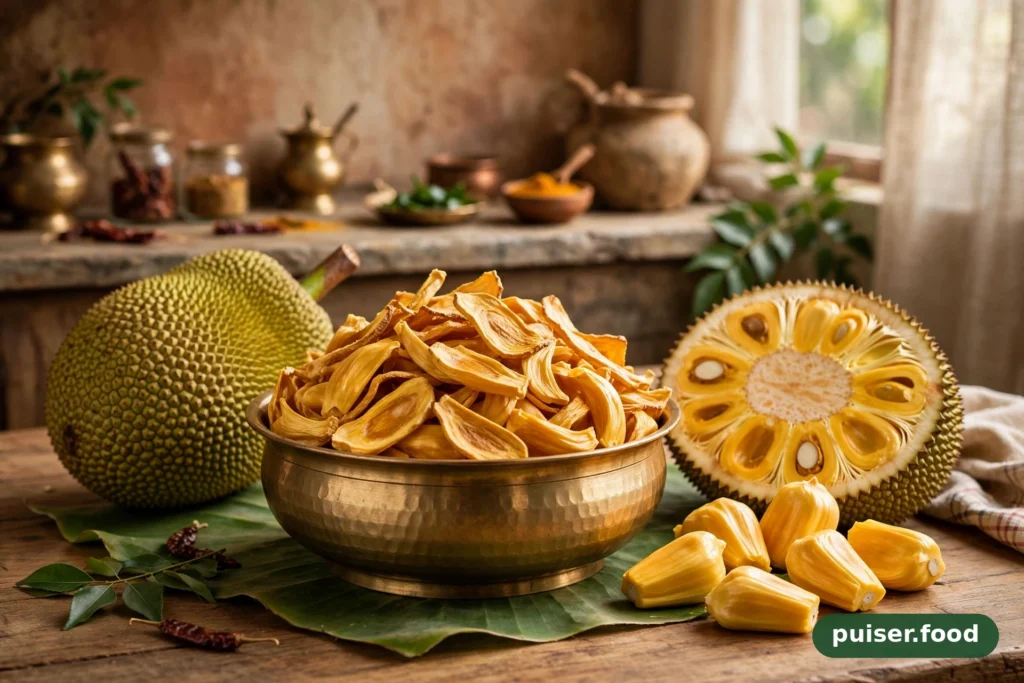
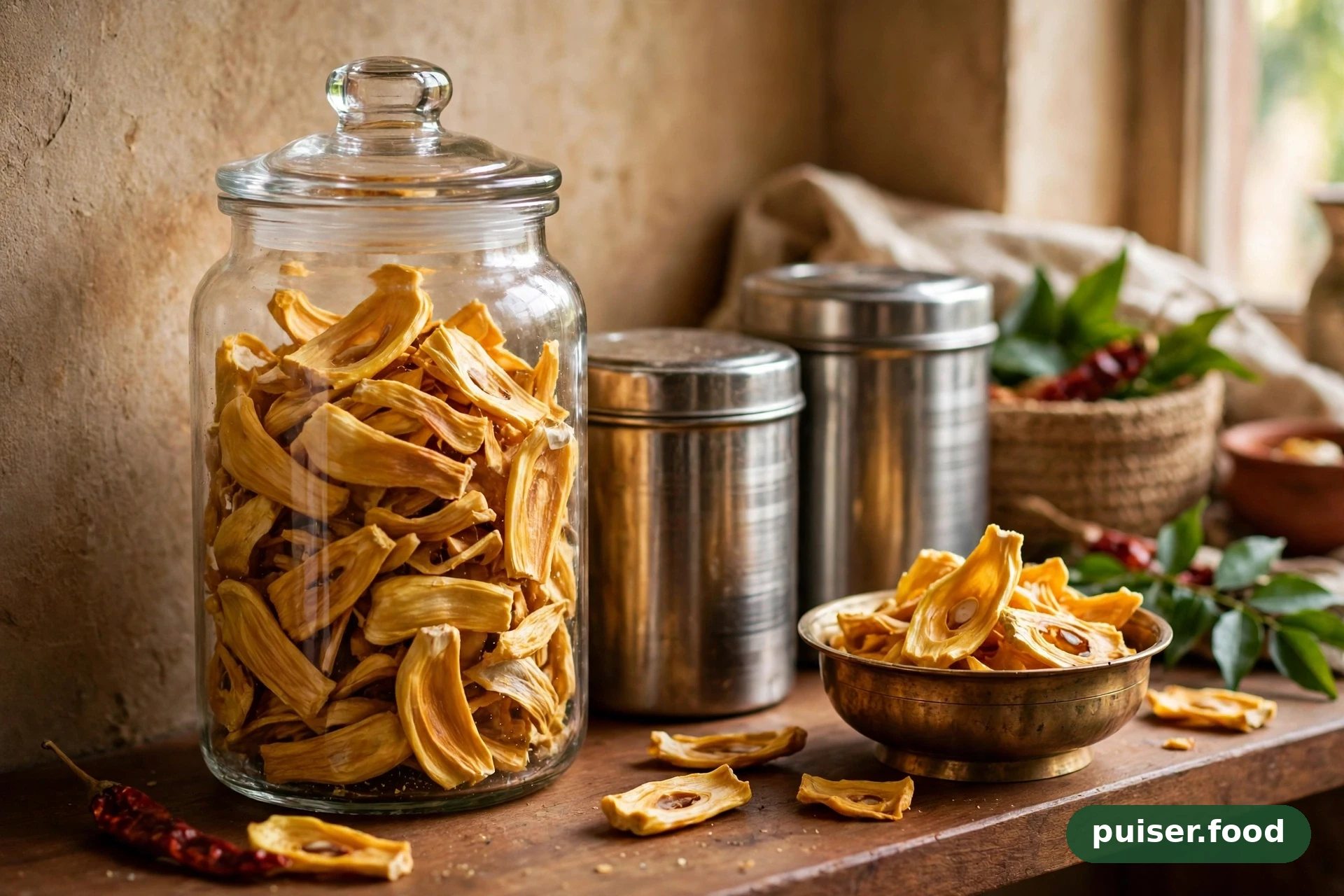
Dried jackfruit is ripe jackfruit bulbs, the yellow flesh called chakka pazham in Malayalam and kathal in Hindi, sliced thin and dried until they turn golden, chewy and sweet. Jackfruit is Artocarpus heterophyllus, and it grows across Kerala, Tamil Nadu, Karnataka, West Bengal and the north east, with the main season running from March to June. One tree in a Kerala backyard can feed a whole lane through the summer, so much of the fruit ends up dried, fried into chips or cooked into chakka varattiyathu, the jaggery preserve that keeps for a year.
That dried jackfruit carries potassium and fibre with its sugar is the first thing to understand, because it is what separates a jackfruit chip from a sweet, and it is where the dried jackfruit benefits start. A chip gives natural sugars with fibre, potassium and vitamin C attached. The fibre slows digestion a little, and the fruit still tastes like a sweet, so dried jackfruit works as a snack and a garnish at once.
Dried jackfruit is also the fruit of the Kerala summer, in the chakka upperi of a tea time plate, in the payasam of an Onam sadya, in the trail mix of a train journey and in the tiffin of a school day. The green unripe fruit is a different food, the kathal of kathal ki sabzi, cooked as a vegetable, and its story belongs to the diabetes section below. Our dried mango benefits guide covers the golden slice with the most sugar of the series, and our dried banana benefits guide covers the chip that most often shares the shelf with jackfruit. Our dried pineapple benefits guide covers the tangy ring with the highest sugars of the dried fruit shelf.
Dried Jackfruit in Numbers
The numbers behind the dried jackfruit benefits need a straight telling, because there is no generic USDA record for dried jackfruit. USDA FoodData Central was searched across its collections, and no generic dried jackfruit entry exists. The only dried jackfruit records are branded products, such as the Nutty and Fruity dried jackfruit, FDC ID 411543, and branded labels disagree with each other. This guide therefore builds its main table from raw jackfruit, clearly labelled as raw, and treats dried figures as ranges from named brands and labels only.
The raw table below uses one record throughout, USDA FoodData Central SR Legacy entry 174687, “Jackfruit, raw”, per 100 g. Raw jackfruit is mostly water, so drying concentrates everything in it. The potassium figure, 448 mg per 100 g, is the one that matters most, and it puts raw jackfruit ahead of banana at 358 mg per 100 g on potassium.
| Nutrient, raw jackfruit (per 100 g) | Amount |
|---|---|
| Energy | 95 kcal |
| Protein | 1.72 g |
| Fat | 0.64 g |
| Carbohydrates | 23.25 g |
| Fibre | 1.5 g |
| Sugars | 19.08 g |
| Water | 73.46 g |
| Sodium | 2 mg |
| Calcium | 24 mg |
| Iron | 0.23 mg |
| Magnesium | 29 mg |
| Phosphorus | 21 mg |
| Potassium | 448 mg |
| Zinc | 0.13 mg |
| Vitamin C | 13.7 mg |
| Vitamin A | 5 mcg RAE |
| Vitamin B6 | 0.33 mg |
The label table below shows what named dried jackfruit products actually print, per 100 g, and it is the reason this guide gives ranges rather than a single dried table. Freeze-dried jackfruit from FruitBuys prints 388 kcal, 67 g of sugars and 7.1 g of fibre. The organic soft-dried jackfruit from Fruits-Tropicaux prints 300 kcal, 64.8 g of sugars and 7.4 g of fibre, with no added sugar. The sweetened Paradise Green pack, which lists cane sugar in its ingredients, prints 325 kcal, 55 g of sugars and 5 g of fibre. Healthy Truth dried slices print 250 kcal per 100 g, and SnapCalorie lists dried jackfruit at 350 kcal, 70 g of sugars and 7.5 g of fibre. No single figure is settled.
| Dried jackfruit product, per 100 g | Energy | Sugars | Fibre | Protein |
|---|---|---|---|---|
| FruitBuys freeze-dried, 100 percent jackfruit | 388 kcal | 67 g | 7.1 g | 7.1 g |
| Fruits-Tropicaux organic soft-dried, no added sugar | 300 kcal | 64.8 g | 7.4 g | 4.4 g |
| Paradise Green sweetened, cane sugar added | 325 kcal | 55 g | 5 g | 0 g |
| Healthy Truth dried slices | 250 kcal | not given | not given | not given |
| SnapCalorie dried jackfruit | 350 kcal | 70 g | 7.5 g | 5 g |
The portion table below turns those label ranges into handfuls people actually eat. Fruits-Tropicaux suggests 30 g as a guide portion for its own product, at 90 kcal, 19.4 g of sugars and 2.2 g of fibre, and a 28 g pack of freeze-dried jackfruit gives 109 kcal, 19 g of sugars and 2 g of fibre. Across the labels above, a 30 g serving gives roughly 75 to 116 kcal, about 17 to 21 g of sugars and about 1.5 to 2.2 g of fibre. It is the portion this guide uses everywhere.
| Portion of dried jackfruit | Energy | Sugars | Fibre |
|---|---|---|---|
| 30 g, a small handful | 75 to 116 kcal | 17 to 21 g | 1.5 to 2.2 g |
| 60 g, two handfuls | 150 to 233 kcal | 33 to 42 g | 3 to 4.4 g |
| 100 g, a full pack | 250 to 388 kcal | 55 to 70 g | 5 to 7.5 g |
The comparison table below puts the four kinds of dried jackfruit side by side. Freeze-dried keeps the most of the fresh fruit and costs the most per 100 g. Soft-dried is the chewy kind most Indian shops sell. Sweetened soft-dried looks the same, and the cane sugar on its ingredients list is the giveaway. Vacuum-fried chips are crisp and fried, with one supplier printing 15 to 22 g of fat per 100 g.
| Kind | What it is | Sugars per 100 g | Best for |
|---|---|---|---|
| Freeze-dried | 100 percent jackfruit, water removed by cold and vacuum | about 67 g | Trail mix, tiffin, garnish |
| Soft-dried, unsweetened | Ripe bulbs hot-air or sun dried, nothing added | about 65 g | Oats, payasam, snacking |
| Soft-dried, sweetened | Ripe bulbs dried with cane sugar | about 55 g on the label | A sweet, not a health snack |
| Vacuum-fried chips | Half-ripe bulbs fried crisp in oil | about 40 to 55 g | Tea time, in small portions |
| Chakka varattiyathu | Ripe jackfruit cooked down with jaggery and ghee | not stated | Payasam base, Onam cooking |
10 Dried Jackfruit Benefits Worth Knowing
Here are the ten dried jackfruit benefits worth knowing, in the order a home cook would care about them. Each one is tied to a number from the tables above or to a study named in the text, and each one belongs to the plain dried kind, not the candied or fried kind.
1. Potassium that actually counts
The first of the dried jackfruit benefits is the potassium. Raw jackfruit gives 448 mg per 100 g, more than banana, and freeze-dried jackfruit prints 1,446 mg per 100 g. A 28 g pack gives about 405 mg, and potassium helps the body balance fluids and supports healthy blood pressure as part of a whole diet.
2. Fibre in a sweet
The second of the dried jackfruit benefits is the fibre. Raw jackfruit gives only 1.5 g of fibre per 100 g, because it is mostly water, and drying concentrates it to about 5 to 7.5 g per 100 g across the labels in the table above. A 30 g serving gives about 1.5 to 2.2 g of fibre, which keeps a small handful filling for longer than a sweet of the same size.
3. Vitamin C, kept honest
Raw jackfruit gives 13.7 mg of vitamin C per 100 g, a fair share for a fruit, and drying keeps part of it. Freeze-drying keeps the most, because it uses cold instead of heat, while hot-air drying cuts it, and one supplier guide puts the vitamin C loss from heat drying at up to half. A 30 g serving is therefore a small help for vitamin C, not a rich source. Eat dried jackfruit for potassium and fibre, and eat a fresh fruit for vitamin C.
4. Vitamin B6 in a snack
Raw jackfruit gives 0.33 mg of vitamin B6 per 100 g, about a fifth of the day, and drying concentrates it along with the rest. Vitamin B6 helps the body use protein and make red blood cells, as part of a whole diet.
5. Quick energy that travels
Dried jackfruit is mostly carbohydrate, and a 30 g serving gives roughly 75 to 116 kcal, which is quick energy in a light pack. A 28 g pack of freeze-dried jackfruit gives 109 kcal, and the same weight of fresh bulbs would be five or six times heavier, so the dried pack carries a whole serving of fruit in a pocket. That is why it suits a train journey, a trek or a school tiffin.
6. A snack with almost no fat
Plain dried jackfruit carries almost no fat. Raw jackfruit gives 0.64 g of fat per 100 g, and the freeze-dried and soft-dried labels print 0 to 0.8 g of fat per 100 g, with no cholesterol. The fried chips are the exception, with one supplier printing 15 to 22 g of fat per 100 g, so the fat figure belongs to the cooking method, not to the fruit.
7. Magnesium in a sweet
Raw jackfruit gives 29 mg of magnesium per 100 g, a small share of the day, and drying concentrates it along with the potassium. Magnesium supports muscle and bone health as part of a whole diet.
8. A snack that keeps for months
Dried jackfruit keeps for months in an airtight jar without a fridge, and freeze-dried packs keep for about 12 months sealed, which makes it one of the best fruits for a train journey, a trek or a school tiffin. Fresh jackfruit goes bad in days, while the dried chips weigh almost nothing and keep their shape in a bag.
9. A small handful that satisfies a sweet craving
A 30 g serving gives roughly 75 to 116 kcal and about 1.5 to 2.2 g of fibre, and the chew and the sweetness satisfy a sweet craving for longer than a biscuit of the same calories. The portion is easy to measure, about a small handful in a small bowl.
10. A fruit that cooks well
Dried jackfruit softens in heat and gives its sweetness to the dish, which makes it one of the few dried fruits that cooks as well as it snacks. A handful of chopped chips in payasam, in oats or in a halwa adds sweetness without extra sugar in the pot, and the chips hold their shape in cooking better than raisins do. That is the benefit that matters most in an Indian kitchen.
The Diabetes Claim, Honestly
The diabetes claim is the part of the dried jackfruit benefits that gives the fruit its confusing reputation, so it deserves a straight telling. In 2021, researchers published a randomised, double-blind, placebo-controlled trial in Nutrition and Diabetes, testing 30 g a day of green jackfruit flour in 40 people with type 2 diabetes for 12 weeks, replacing an equal volume of rice or wheat flour at breakfast and dinner. HbA1c fell by 0.25 percent in the jackfruit flour group against a rise of 0.02 percent in the placebo group. Fasting and after-meal glucose fell too. The trial was run in India, at the Rajiv Gandhi Institute of Medical Sciences in Srikakulam, Andhra Pradesh.
The honest version is this. The trial tested green jackfruit flour, made from dehydrated mature unripe jackfruit, the vegetable, not the ripe sweet fruit, and it replaced rice or wheat, so the benefit came from swapping a starchy flour for a fibre-rich one. Dried jackfruit chips are made from ripe bulbs, and their sugars run about 55 to 70 g per 100 g across the labels in this guide, so a small serving has a real effect on blood sugar, and no green flour trial changes that. People with diabetes can eat a small serving, about 30 g, as the sweet of the meal. What dried jackfruit is not is a diabetes food, and anyone selling the chips as one is selling a flour trial, not a chip result.
The sugar on the label is the other thing to read. Some packs list cane sugar in the ingredients, and a pack that lists sugar is a candied sweet rather than a dried fruit. Some packs also carry sodium metabisulfite as a preservative, as the Paradise Green label does, so sensitive buyers, especially people with asthma, should pick a pack with one ingredient, jackfruit, and nothing else. The plainest pack is the best buy. Freeze-dried jackfruit guides also note a rare allergy in people allergic to birch pollen or latex, so anyone with a latex allergy should try a small piece first.

Freeze-Dried Versus Sun-Dried Versus Sweetened Versus Chips
The benefits do not change much between the firm thenvarikka bulbs and the soft koozha chakka bulbs, because the fruit is similar, but they change between the ways it is dried. Freeze-dried jackfruit is frozen at about minus 35 to minus 40 degrees, then the ice is removed under vacuum, so the fruit is never cooked, and it keeps most of its vitamin C and colour. Sun-dried and hot-air dried jackfruit use heat, which cuts vitamin C and darkens the colour, and the chips turn chewy rather than crisp. The freeze-dried kind costs far more per 100 g and crushes easily, so it suits a trail mix better than a tiffin box.
The sweetened kind is the trap on the shelf. It looks like the plain kind, and the cane sugar on its ingredients list is easy to miss, and the Paradise Green label prints 55 g of sugars per 100 g with 0 g of protein. The fried chips are a different food again. Kerala chakka upperi is made from half-ripe bulbs, sliced thin, dusted with turmeric and fried crisp in coconut oil, and vacuum-fried packs print about 380 to 420 kcal and 15 to 22 g of fat per 100 g. Check the fat per 100 g before buying. A cup of sliced fresh bulbs, about 165 g, gives about 157 kcal with about 22.6 mg of vitamin C and 2.5 g of fibre, so the fresh fruit wins on vitamin C and hydration, while the dried chip wins on potassium and fibre per gram.
Five Everyday Ways to Use It
The dried jackfruit benefits show up best in five everyday dishes, each one using a small serving rather than a bowlful, with the jackfruit at 30 g or less.
1. Oats porridge with cinnamon
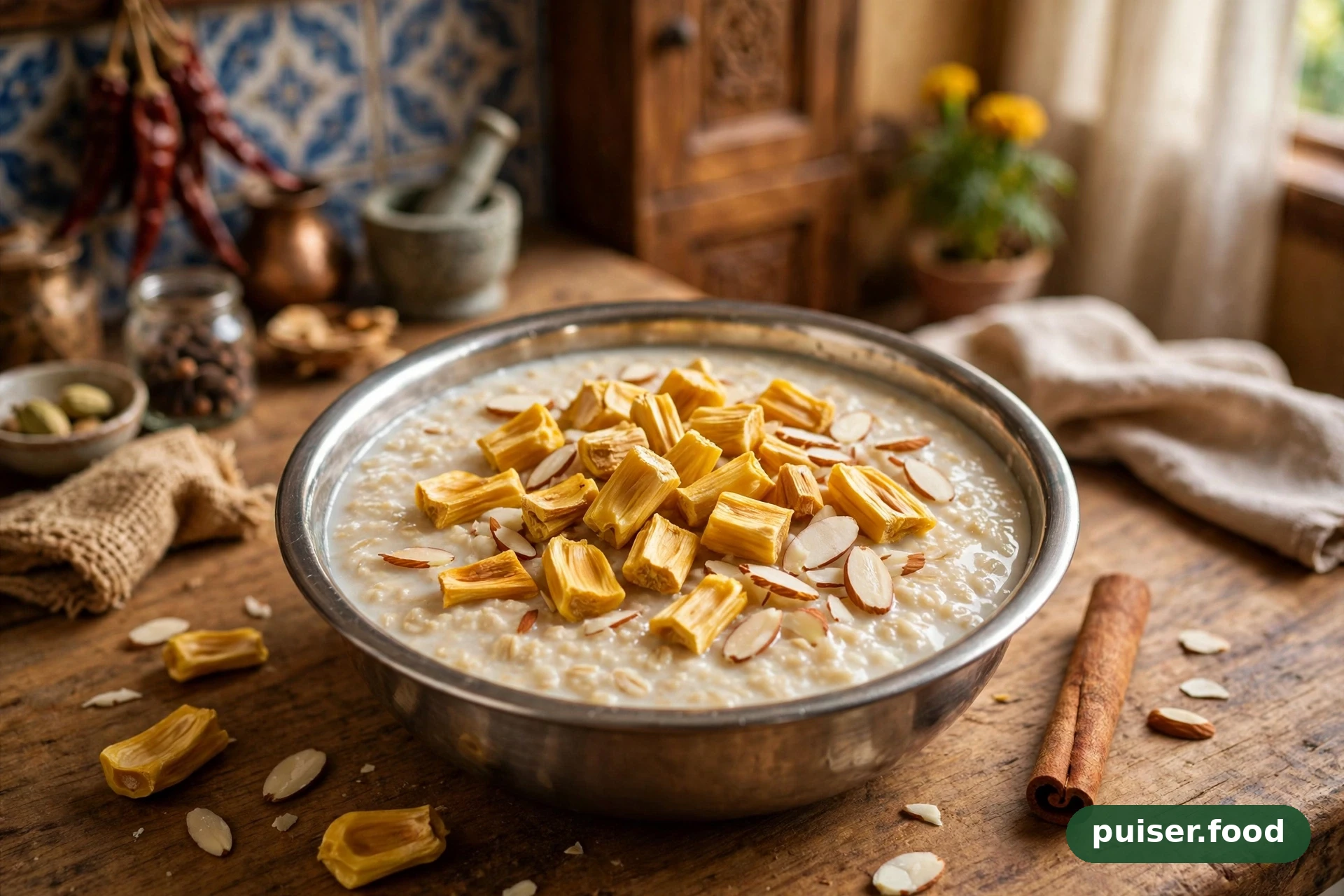
Stir 30 g of dried jackfruit, chopped small, into a bowl of oats cooked in milk, with a pinch of cinnamon and no extra sugar, and the chips soften in the heat and turn the oats sweet and fragrant. The bowl needs no jaggery or honey, because the jackfruit carries the sweetness.
2. Chakka varatti payasam with coconut milk
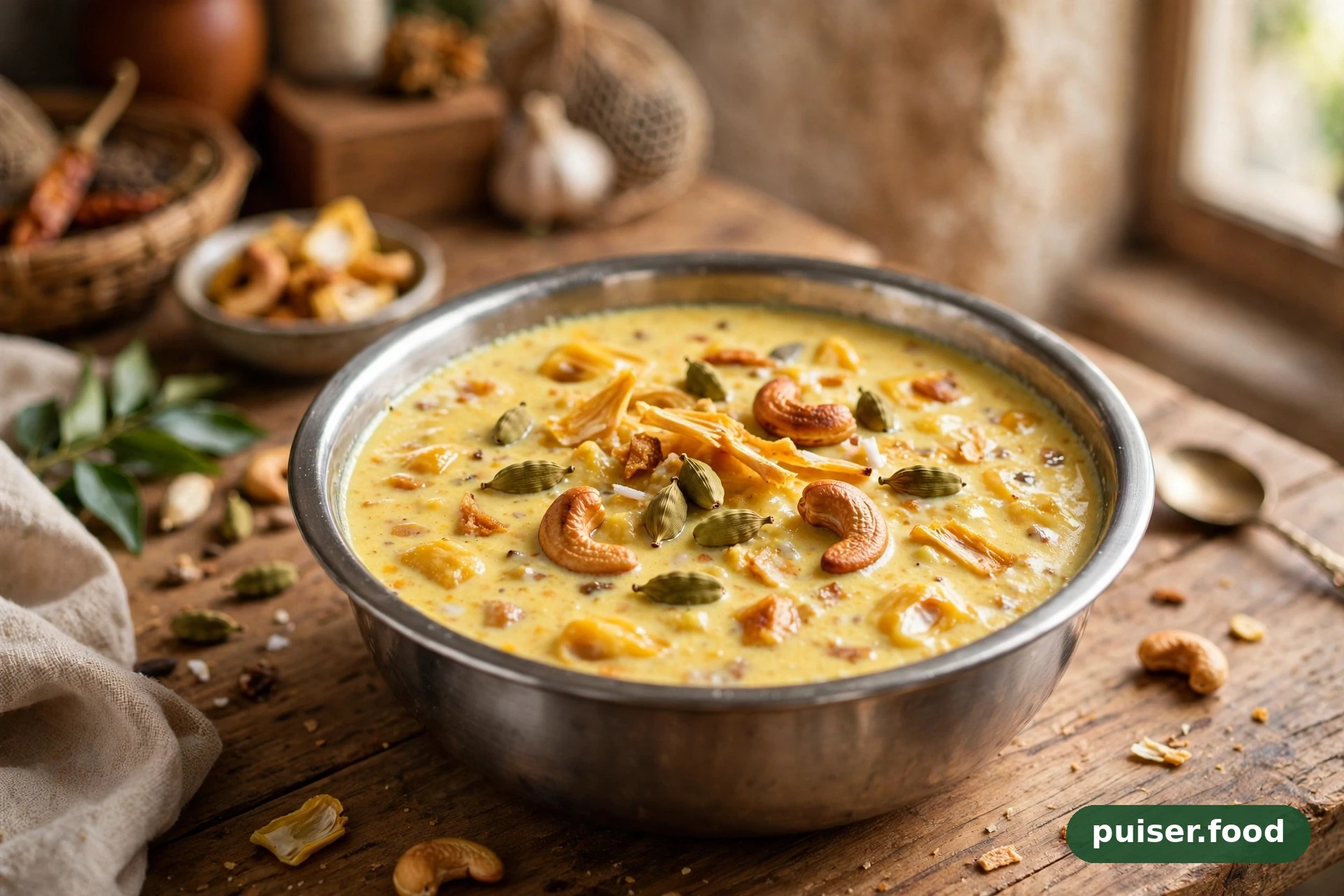
Simmer 30 g of dried jackfruit, chopped small, in a pot of payasam with coconut milk and cardamom for the last ten minutes, and the chips soften and give their sweetness to the milk, so the payasam needs less jaggery than usual. The golden colour makes the payasam look like a festival dish.
3. Trail mix with almonds and seeds
Mix 30 g of dried jackfruit, torn small, with a handful of almonds and walnuts and a spoon of pumpkin seeds, and the mix travels well in a small dabba for a train journey or a desk. The jackfruit gives the chew and the sweetness, the nuts give the crunch.
4. Curd bowl with honey
Spoon 30 g of dried jackfruit over a bowl of thick curd with a teaspoon of honey and a few chopped almonds, and the curd gives the protein, the jackfruit gives the sweetness and the chew, and the almonds give the crunch. The curd and nuts slow the sugars down so the snack stays filling for longer.
5. Poha with peanuts and curry leaves
Toss 30 g of dried jackfruit, chopped small, into a plate of poha with roasted peanuts, curry leaves and a squeeze of lemon, and the jackfruit gives the poha a sweet softness against the salt of the peanuts and the sharpness of the lemon. The plate needs no extra sugar.
Buying and Storing Dried Jackfruit
The dried jackfruit benefits survive or die on the label, so buy by the label, not by the price alone. The ingredients list should read jackfruit, and a pack that lists cane sugar is a candied sweet rather than a dried fruit. Pick the plainest pack with one ingredient. Check the sugars per 100 g too, because a pack at 70 g of sugars is a different snack from a pack at 55 g.
For the snack box, our Organic Dried Papaya is the plain dried kind in the Puiser shop, made for the oats bowl and the trail mix. Store dried jackfruit in an airtight jar in a cool, dark place, where it keeps for months. Its sugars attract moisture, so a pack left open in a humid kitchen will turn sticky and clump, and freeze-dried chips go soft fastest of all. Throw the chips away if they smell sour, taste fermented or show mould.
5 Expert Tips
1. Count the handful. Count a small handful, about 30 g, into a small bowl and put the pack away, because a handful eaten from the pack is usually two, and the sugar adds up fast.
2. Soak before cooking. Soak dried jackfruit in warm water for ten minutes before adding it to payasam or oats, so it softens and gives its sweetness to the dish.
3. Pair with curd for protein. Eat dried jackfruit with curd or nuts rather than alone, because the protein and fat slow the sugars down and keep the snack filling for longer.
4. Buy plain for sensitive eaters. Buy a one-ingredient pack for children and for anyone with asthma, because metabisulfite can trouble sensitive eaters and the colour makes no difference to the taste.
5. Check the sugars per 100 g. Check the sugars per 100 g before buying, because the labels in this guide run from 55 g to 70 g.
Common Mistakes to Avoid
Eating by the packful. The commonest mistake is treating dried jackfruit like fresh jackfruit and eating a whole 100 g pack, about 55 to 70 g of sugars. A small handful is the portion.
Buying the sweetened kind by mistake. The sweetened kind lists cane sugar in its ingredients and tastes like a sweet, and the plain kind lists jackfruit alone. Check the ingredients before buying.
Expecting a vitamin C food. Dried jackfruit keeps only part of the 13.7 mg of vitamin C in raw jackfruit, because heat drying cuts it. Eat dried jackfruit for potassium and fibre, and eat a fresh fruit for vitamin C.
Storing in the open pack. A pack left open in a humid kitchen turns sticky, clumps and can ferment. Move the chips to an airtight jar on the day the pack is opened.
Believing the diabetes claim. The diabetes claim rests on a trial of green jackfruit flour, not on human trials of dried ripe chips. Dried jackfruit carries about 55 to 70 g of sugars per 100 g, so a small serving is the portion.
Frequently Asked Questions
What are the main benefits of dried jackfruit?
Dried jackfruit benefits centre on potassium, fibre and vitamin C, with raw jackfruit giving 448 mg of potassium and 13.7 mg of vitamin C per 100 g, and dried labels printing about 5 to 7.5 g of fibre per 100 g. The benefits belong to the plain dried kind, not the sweetened or fried kind.
Is dried jackfruit healthy?
Dried jackfruit is healthy in a small portion, because it is one ingredient with potassium, fibre and almost no fat, and no added sugar in the plain kind. The catch is the sugar. Dried labels print about 55 to 70 g of sugars per 100 g, so a 30 g handful is a fruit serving, and a whole pack is a sweet.
Is dried jackfruit good for diabetes?
Dried jackfruit is sugar dense, about 55 to 70 g of sugars per 100 g, so a small serving affects blood sugar. The diabetes trial tested green jackfruit flour, made from unripe fruit, not dried ripe chips, so it does not settle the chips. People with diabetes should count them as the sweet of the meal and ask their own doctor.
What is the difference between freeze-dried, sun-dried and sweetened dried jackfruit?
Freeze-dried jackfruit is dried by cold and vacuum, keeps the most vitamin C and colour, and costs the most. Sun-dried and hot-air dried jackfruit use heat, turn chewy and darker, and lose more vitamin C. Sweetened dried jackfruit has cane sugar added, and it is a candied sweet rather than a plain dried fruit.
How much dried jackfruit can I eat in a day?
About 30 g a day, a small handful, is the daily portion this guide uses, with roughly 75 to 116 kcal and about 17 to 21 g of sugars. Eating more is fine on some days, but a whole 100 g pack carries 55 to 70 g of sugars, so count the handful rather than eating from the pack.
Is dried jackfruit good for weight loss?
A 30 g handful, roughly 75 to 116 kcal, suits a weight loss diet better than a biscuit of the same calories, because the fibre makes it filling. The catch is the portion. Dried jackfruit is sugar dense and the calories add up fast from the pack, so it works only when the handful is counted.
Does dried jackfruit help with constipation?
Dried jackfruit gives about 5 to 7.5 g of fibre per 100 g, and a 30 g serving gives about 1.5 to 2.2 g, so it helps a fibre free diet a little. It is not a laxative, and a small serving will not fix a diet with no fibre at all. Drink water with the chips, because fibre works best with water.
Is dried jackfruit good for pregnancy?
Dried jackfruit gives potassium, fibre and vitamin C in useful amounts, and a small serving fits a healthy pregnancy diet. The caution is the sweetened kind, which carries added cane sugar, and packs with metabisulfite. Ask your own doctor about portions, and buy the plain one-ingredient kind.
Can children eat dried jackfruit?
Children can eat dried jackfruit in small servings, and the sweet chew makes it an easy tiffin fruit. Buy the plain unsweetened kind for children, and cut the chips small for young children, because the chewy pieces can be a choking risk.
Does dried jackfruit have side effects?
The main side effects are sugar and sulphites. Dried jackfruit carries about 55 to 70 g of sugars per 100 g, and some packs carry sodium metabisulfite, which can trouble people with asthma. A rare allergy is also reported in people allergic to birch pollen or latex, so try a small piece first if that applies.
Conclusion
Dried jackfruit earns its place in the snack box when the pack is plain and the portion is a small handful. The dried jackfruit benefits, potassium and fibre and a little vitamin C, make it a better sweet than a biscuit, and the golden chips travel well, keep for months and turn a payasam or an oats bowl into a small treat. The trap is the diabetes claim and the sweetened pack, and the fix is a label check, because the plainest pack is the best buy. Try a small handful in oats, in payasam or over curd.
Disclaimer: This article is for general information only and is not medical advice. If you have diabetes, asthma, a sulphite sensitivity or a latex allergy, talk to your doctor before making dried jackfruit a daily habit.