Introduction
Quinoa is the tiny seed that turns up as khichdi on a weeknight, as pulao in a tiffin box, and as a salad on a summer lunch table. It came to India from the Andes, where it grew on high mountain terraces, and it settled into Indian kitchens because it cooks like a grain, takes a tempering well, and carries more protein than rice. This guide covers the quinoa benefits that matter most, the protein story told honestly, the rinse step that keeps it from tasting bitter, and the five best Indian ways to cook it.
In this article
- The short answer
- What quinoa actually is
- Quinoa in numbers
- 10 quinoa benefits worth knowing
- The complete protein claim, honestly
- White, red and black, grain and flour
- Five everyday ways to use it
- Buying and storing quinoa
- 5 expert tips
- Common mistakes to avoid
- Frequently asked questions
- Conclusion
The Short Answer
The quinoa benefits that matter most are protein quality, fibre and steady energy, in a seed that is naturally gluten free. Raw quinoa gives 14.1 g of protein, 7.0 g of fibre and 368 kcal per 100 g, and cooked quinoa gives 4.4 g of protein, 2.8 g of fibre and 120 kcal in the same weight. A cup of cooked quinoa, 185 g, holds 222 kcal, 8 g of protein and 5 g of fibre. The seed must be rinsed before cooking, the protein claim needs its honest half, and the dry calorie figure is not the plate figure.
What Quinoa Actually Is
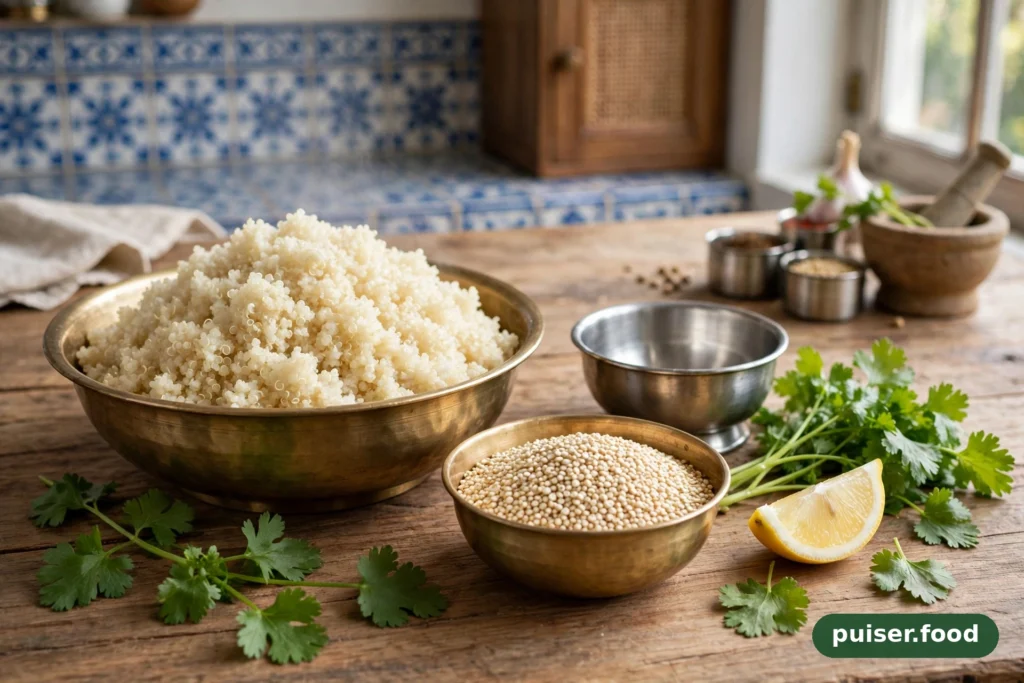
Quinoa is the seed of a broad-leafed plant from the Andes, not a cereal grass, which is why it is called a pseudocereal. The seed is small, round and pale gold, about the size of a mustard seed, and it cooks into a soft grain that shows a tiny white tail when it is done. It grows at high altitude in Peru and Bolivia, where it fed mountain villages for thousands of years, and it reached Indian shelves only in the last decade, first in health stores and then in ordinary kirana shops.
That a seed this small carries complete protein is the first thing to understand, because it is what separates quinoa from wheat and rice, and it is where the quinoa benefits start. The protein carries all nine essential amino acids, including lysine, the one most cereals lack. The seed also carries fibre in amounts most grains cannot match, and it carries that fibre with a mild, nutty taste that takes on cumin, ginger and lemon without a fight.
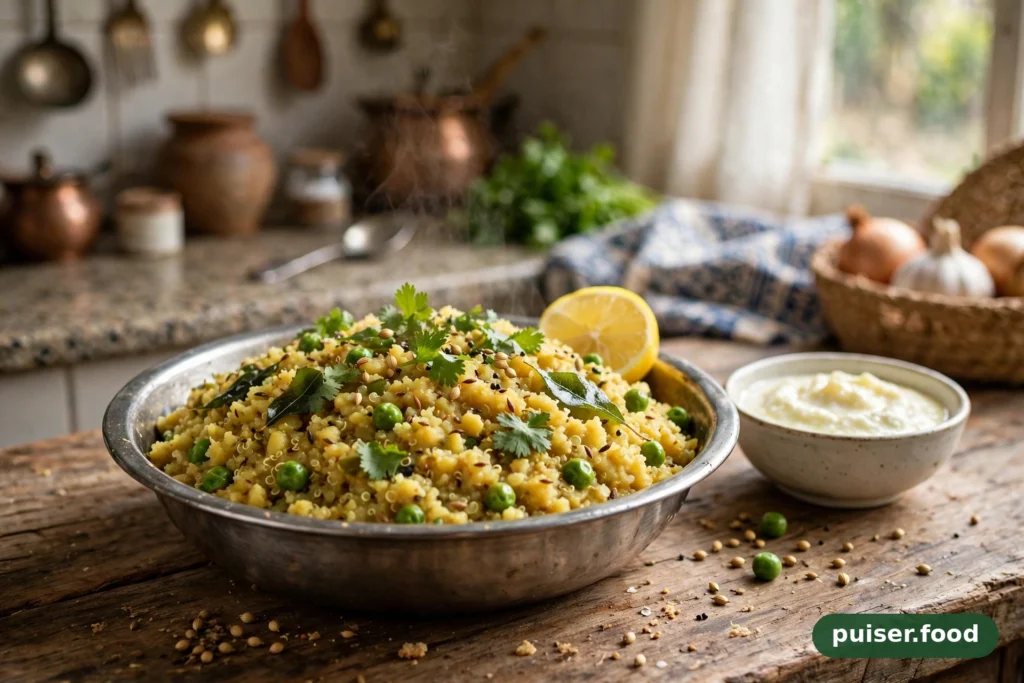
Quinoa is also the seed of the Indian weeknight now, in the khichdi of a light dinner, in the pulao of a tiffin box, in the upma of a quick breakfast and in the salad of a summer lunch. A bowl of quinoa khichdi shows the seed at its best, soft and filling without sitting heavy. The grain makes pulao and khichdi, the flour makes rotis and cheelas for those who want them, and the cooked seed tossed cold makes a salad that keeps well in the fridge.
Quinoa in Numbers
The numbers behind the quinoa benefits need a straight telling, because this time the USDA record is unusually clean. USDA FoodData Central holds a record for quinoa, FDC ID 168874, “Quinoa, uncooked”, from the SR Legacy dataset, and a cooked record, FDC ID 168917. This guide uses those two records only, with all figures per 100 g unless a portion is named.
| Nutrient, quinoa raw (per 100 g) | Amount |
|---|---|
| Energy | 368 kcal |
| Protein | 14.1 g |
| Fat | 6.1 g |
| Carbohydrates | 64.2 g |
| Fibre | 7.0 g |
Three figures in that table do most of the work. Protein at 14.1 g per 100 g is the headline, higher than most grains, and fibre at 7.0 g per 100 g is the second. Fat at 6.1 g per 100 g is the third, higher than rice and worth knowing for storage, because a fat-rich grain goes stale faster in an open pack. Carbohydrates at 64.2 g per 100 g are the bulk of the seed, and the fibre beside them is what slows them down.
| Nutrient (per 100 g) | Raw quinoa (FDC 168874) | Cooked quinoa (FDC 168917) |
|---|---|---|
| Energy | 368 kcal | 120 kcal |
| Protein | 14.1 g | 4.4 g |
| Carbohydrates | 64.2 g | 21.3 g |
| Fibre | 7.0 g | 2.8 g |
| Fat | 6.1 g | 1.9 g |
Cooking adds water, and water carries no nutrients, so every figure per 100 g falls. Raw quinoa gives 368 kcal per 100 g and cooked quinoa gives 120 kcal, and protein falls from 14.1 g to 4.4 g in the same weight. That is not a loss of nutrients, only dilution. A cup of cooked quinoa still carries the protein of the dry grain that went into the pot.
The portion table below turns the per 100 g figures into katoris and cups. One cup of dry grain weighs 170 g, far more than a serving, and carries 626 kcal and 24.0 g of protein. The 50 g serving is the portion this guide uses everywhere, a small katori of dry grain that cooks into a full bowl.
| Portion of quinoa | Energy | Protein | Fibre | Carbohydrates |
|---|---|---|---|---|
| 50 g dry, a small katori | 184 kcal | 7.1 g | 3.5 g | 32.1 g |
| 100 g dry | 368 kcal | 14.1 g | 7.0 g | 64.2 g |
| 170 g dry, one cup | 626 kcal | 24.0 g | 11.9 g | 109.1 g |
| 185 g cooked, one cup | 222 kcal | 8 g | 5 g | 39.4 g |
The form changes the cooking, not the nutrition. Grain and flour from the same plain pack carry the same figures per 100 g of dry grain. Only a pulao or a kheer moves the figures, with ghee, peanuts or sugar added in the cooking. Read the recipe, not the colour.
| Grain (per 100 g raw) | Energy | Protein | Fibre |
|---|---|---|---|
| Quinoa (USDA FDC 168874) | 368 kcal | 14.1 g | 7.0 g |
| Amaranth (USDA FDC 170682) | 371 kcal | 13.6 g | 6.7 g |
| Buckwheat (USDA FDC 170286) | 343 kcal | 13.3 g | 10.0 g |
| Brown rice (USDA) | 362 kcal | 7.5 g | 3.4 g |
Quinoa leads on protein, buckwheat leads on fibre, and brown rice trails both, so no single grain wins every row. Our amaranth benefits guide covers the fasting grain with the closest protein figure, and our buckwheat benefits guide covers the other gluten free pseudocereal on the shelf. Our foxtail millet benefits guide covers the millet that leads on fibre, and our ragi benefits guide covers the calcium leader of the Indian shelf.
10 Quinoa Benefits Worth Knowing
Here are the ten quinoa benefits worth knowing, in the order a home cook would care about them. Each one is tied to a number from the tables above or to a caution named in the text, and each one belongs to the cooked grain, not the raw seed.
1. Protein quality that stands out
The first benefit is the protein quality. Quinoa gives 14.1 g of protein per 100 g of raw grain, and the protein carries all nine essential amino acids, including lysine, which wheat and rice lack. A 50 g serving gives about 7 g of protein, a useful share of a vegetarian meal. The quantity is still smaller than a dal, and the honest half of the claim is told below.
2. Fibre that keeps you full
Quinoa gives 7.0 g of fibre per 100 g of raw grain, and a 50 g serving gives about 3.5 g. Fibre slows digestion, keeps you full for longer, and supports gut health. The grain’s fibre is the quiet reason a small katori of porridge satisfies more than a plate of white rice of the same calories, and it is why quinoa suits a light dinner.
3. Gluten free by nature
Quinoa is naturally gluten free, because it is a seed, not a wheat, and that makes it one of the few grains a person with coeliac disease can eat without worry. It also suits kitchens that cook without wheat for other reasons. Check the pack for a gluten free label if the grain is packed in a shared facility.
4. Slow, steady energy
Quinoa gives 64.2 g of carbohydrates per 100 g of raw grain, with 7.0 g of fibre alongside, and its glycaemic index sits around 53. The fibre slows the carbohydrates down, so the energy lasts longer than the same calories from white rice. That is why a katori of quinoa khichdi suits a morning that runs long, and why it works as a light dinner.
5. A full plate for 222 kcal
A cup of cooked quinoa, 185 g, holds 222 kcal with 8 g of protein and 5 g of fibre, which is a full plate for the calories. The grain swells in volume as it cooks, so a small katori of dry grain fills a bowl. That is the portion to count, because a second cup adds another 222 kcal without feeling like much more food.
6. Cooks in one pot, no soaking
Quinoa needs no soaking and cooks in one pot, which makes it an easy grain for a weeknight. Rinse it, add water, cover and cook on a low flame until the grains turn translucent and the little white tails show. The pot needs watching only at the end, when the water runs low and the grain can catch.
7. Carries flavour well
Quinoa tastes mild and a little nutty, which is why it takes a tempering so well. Cumin, mustard seeds, ginger, curry leaves and lemon all sit comfortably on it, and the grain carries them without turning the dish into something else. That is what lets it stand in for rice in a pulao or an upma without a new recipe to learn.
8. Made for meal prep
Cooked quinoa keeps well in the fridge, so one pot on Sunday covers salads and tiffin boxes through the week. Cool it quickly, store it in a covered steel dabba, and reheat only the portion you need. The grain holds its shape when reheated, which is more than rice does after a day in the fridge.
9. Suits a weight loss plate
A 50 g serving, about 184 kcal dry and 222 kcal as a cooked cup, suits a weight loss diet better than a plate of white rice of the same calories, because the fibre and protein make it filling. The catch is the portion. Quinoa swells as it cooks, so a second katori adds up fast, and a pulao rich in ghee and peanuts is a different dish from plain boiled quinoa.
10. One seed, many dishes
Quinoa cooks as a grain, grinds into a flour, and tosses cold into a salad, and the three forms cover breakfast, lunch and dinner. The grain makes khichdi, pulao and upma, the flour makes rotis and cheelas, and the cooked seed makes a salad that travels well. Few grains stretch that far, and the dry grain keeps for months in a jar, so a single pack covers many meals.
The Complete Protein Claim, Honestly
The complete protein story is the part of the quinoa benefits that most often gets told wrong, so it deserves a straight telling, along with the calorie and antioxidant stories beside it. None of the three is a reason to skip quinoa, only to cook it right and count it right.
The complete protein claim
Quinoa is called a complete protein because its protein carries all nine essential amino acids, the ones the body cannot make. Most cereals lack lysine, and quinoa has it, which is a real difference. The claim is about quality, not quantity. Quinoa gives 14.1 g of protein per 100 g of dry grain and 4.4 g cooked, while dals give far more protein by the same weight, so a katori of quinoa is not a substitute for a katori of dal. Treat quinoa as a grain with better protein, and pair it with dal, curd or milk for the quantity.
The calorie figure, dry vs cooked
Quinoa is not a low-calorie food. Dry quinoa gives 368 kcal per 100 g, close to rice and wheat, and the low figure everyone quotes is the cooked one, 120 kcal per 100 g, because cooking swells the weight with water. A cup of cooked quinoa holds 222 kcal, which is a fair plate, and a cup of dry grain holds 626 kcal, which is a day’s grain in one measure. Count the dry grain before it goes into the pot, and the cooked figure will take care of itself.
The antioxidant claims, honestly
Quinoa contains flavonoids, the plant compounds behind many antioxidant claims, and laboratory studies show them in the seed. That is lab work, not proof that a bowl of khichdi protects against disease, and no human trial has shown that eating quinoa changes antioxidant levels in the body in a meaningful way. The seed is worth eating for its protein, fibre and steady energy, which are measured, and the flavonoid story can wait for better evidence.
White, Red and Black, Grain and Flour
The quinoa benefits do not change much between the colours on the shelf, because the seed is the same, but they change between the ways it is cooked. White quinoa is the commonest, soft and quick to cook, and it suits khichdi and porridge. Red and black quinoa hold their shape better and suit salads, where the grains need to stay separate. The colour is a variety, not a better seed, so buy white for everyday cooking and red or black when the dish is a salad.
The grain is the whole seed, and it makes khichdi, pulao and upma. The flour is the grain ground fine, and it makes rotis and cheelas, though it has no gluten, so the dough needs hot water and a gentle hand. Quinoa rotates well with red rice and barley through the week, and our red rice benefits guide and our barley benefits guide cover both grains in the same detail as this one. Buy the grain for cooking, and the flour only when the dish needs it.
Five Everyday Ways to Use It
The quinoa benefits show up best in five everyday dishes, each one using a small serving rather than a bowlful, with the dry grain at 50 g or less per serving.
1. Quinoa khichdi with moong dal
Cook the rinsed grain with moong dal and chopped vegetables in a pressure cooker or a pot, then temper with cumin, ginger and ghee, and finish with lemon and coriander. The dal adds the protein the grain lacks in quantity, and the lemon lifts the meal. Serve hot with curd, as a light lunch or a weeknight dinner.
2. Quinoa vegetable pulao
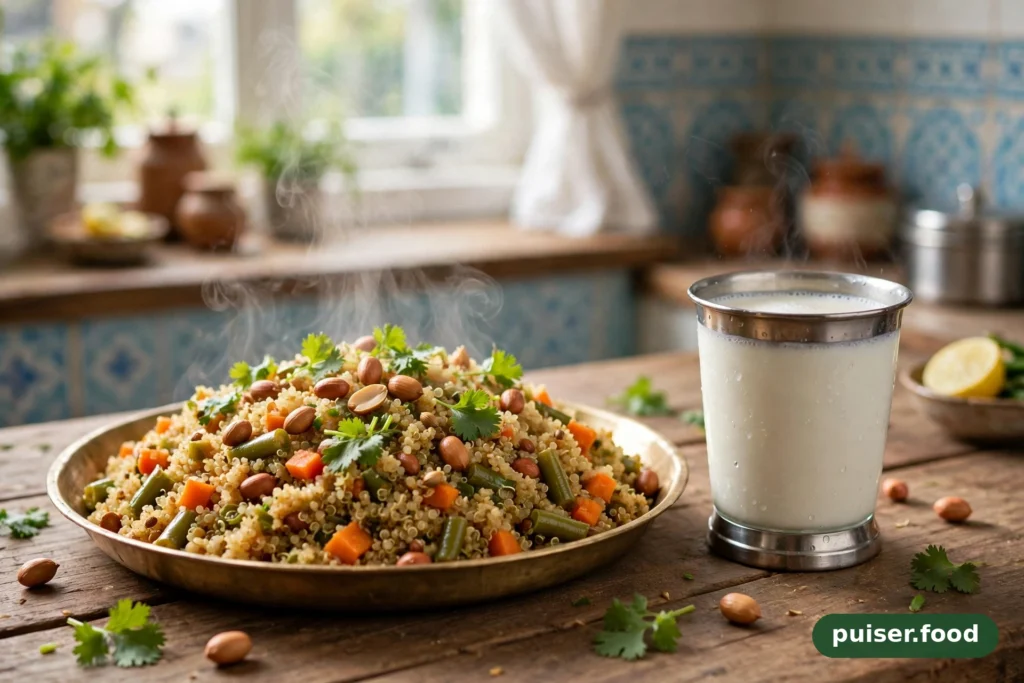
Toast the rinsed grain in a little ghee with whole spices, add chopped carrots, beans and peas, then cook covered on a low flame until the grains turn soft and separate. Finish with roasted peanuts and coriander, and serve with raita. The pulao travels well, so it suits a tiffin box as much as a dinner plate.
3. Quinoa upma with peanuts
Temper mustard seeds, urad dal, curry leaves and green chillies in oil, add onions and the rinsed grain with water, and cook covered until soft. Stir in roasted peanuts and a squeeze of lemon, and serve hot for breakfast. The upma cooks in one pot and needs no soaking, which is why it suits a busy morning.
4. Quinoa salad with cucumber and pomegranate
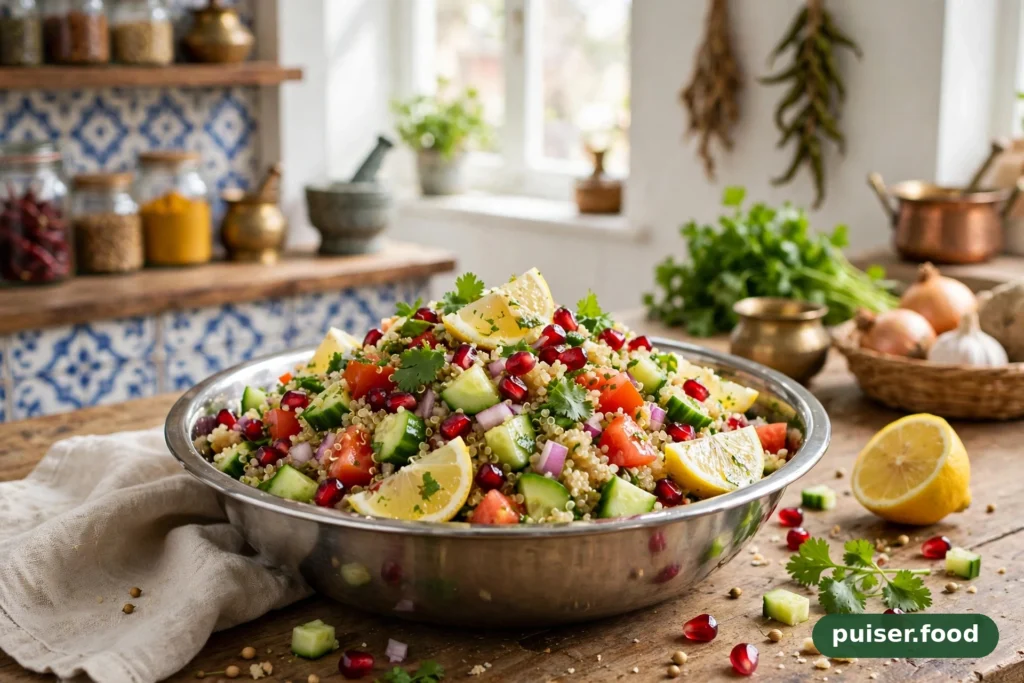
Toss cooled, cooked quinoa with chopped cucumber, tomato and onion, pomegranate seeds and coriander, then dress with lemon juice, salt and a little olive oil. The salad keeps in the fridge and tastes better after an hour, when the lemon has soaked into the grain. Serve it as a light lunch or beside a dal and roti dinner.
5. Quinoa kheer with cardamom
Simmer a small katori of quinoa in milk on a low flame, stirring often, until the grains turn soft and the milk thickens, then add cardamom and a little jaggery and finish with chopped pistachios. The grain gives the kheer its body, so it needs less sugar than a rice kheer. Serve warm in a steel bowl, or chill it for a summer dessert.
Buying and Storing Quinoa
The quinoa benefits survive or die on the label, so buy by the label, not by the price alone. The ingredients list should read quinoa, and a pack that lists anything else is a mix. Whole grain keeps longest, and flour goes stale fastest because the grain carries 6.1 g of fat per 100 g, so buy flour in small packs and use it within weeks. A pack that smells stale or bitter before cooking will taste worse after it.
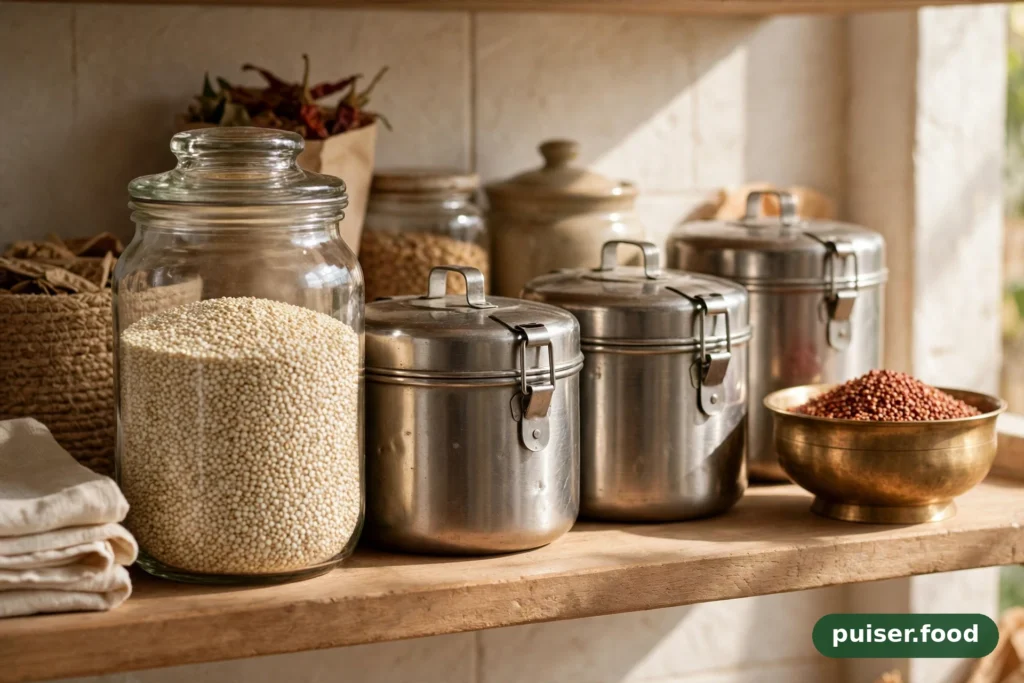
For the pantry, our Organic Quinoa grain is the plain whole grain in the Puiser shop, made for the khichdi, the pulao and the salad. Store the grain in an airtight jar in a cool, dark place, where it keeps for months, and keep flour in the fridge once opened. Throw the grain away if it smells stale or rancid, or if it shows mould.
5 Expert Tips
Five small habits keep the quinoa benefits on the plate and the bitterness out of the pot.
1. Rinse before cooking. Rinse the grain in a sieve under running water, rubbing it gently with your fingers, before it goes into the pot, because the seed coat carries saponins, and the rinse takes the bitter taste off.
2. Toast it first. Toast the rinsed grain in a little ghee until it smells nutty, because the heat brings out the flavour and keeps the grains separate in the pot.
3. Cook it covered, on a low flame. Cook the grain covered on a low flame until the seeds turn translucent and the little tails show, and add a little more water if the pot runs dry, because high heat scorches the bottom before the grain is done.
4. Rest it before fluffing. Rest the pot off the heat with the lid on for a few minutes, then fluff the grain with a fork, because the steam finishes the cooking and the fork keeps the grains separate.
5. Count the 50 g serving. Count a small katori of dry grain, about 50 g, into the pot and put the pack away, because the grain swells as it cooks and a second katori is easy to add by mistake.
Common Mistakes to Avoid
Skipping the rinse. Unrinsed quinoa tastes bitter, because saponins sit on the seed coat. Rinse the grain well in a sieve before cooking, and the bitterness goes.
Counting dry calories as plate calories. Dry quinoa gives 368 kcal per 100 g, and cooked quinoa gives 120 kcal, so a plate holds the cooked figure. Count the dry grain, and do not fear the cooked cup.
Treating it as a protein food. Quinoa gives 14.1 g of protein per 100 g dry, while dals give far more by weight. Pair it with dal or curd, and do not let it carry the meal’s protein alone.
Adding too much water. Too much water turns quinoa into mush, and the grains lose their shape. Cook it covered on a low flame, and add water a little at a time if the pot runs dry.
Leaving cooked quinoa out. Cooked quinoa spoils like cooked rice, so cool it quickly and keep it in a covered dabba in the fridge, and finish it within a couple of days. Reheat only the portion you need.
Frequently Asked Questions
What are the main benefits of quinoa?
Quinoa benefits centre on protein quality, fibre and steady energy, with raw grain giving 14.1 g of protein, 7.0 g of fibre and 368 kcal per 100 g. The protein carries all nine essential amino acids, and the seed is naturally gluten free. The portion is a 50 g serving of dry grain a day.
Is quinoa good for daily eating?
Yes, quinoa suits daily eating in a small portion, because it is a whole seed with protein, fibre and steady energy, and it cooks into khichdi, pulao and upma. Rotate it with other grains through the week rather than eating it at every meal. A 50 g serving of dry grain a day is a sensible portion.
Is quinoa good for diabetes?
Quinoa gives 64.2 g of carbohydrates per 100 g dry, with 7.0 g of fibre alongside, and its glycaemic index sits around 53, so a serving affects blood sugar. The fibre slows it down, and pairing it with dal and vegetables helps further. People with diabetes should ask their own doctor about portions before eating it daily.
Is quinoa gluten free?
Yes, quinoa is naturally gluten free, because it is the seed of a broad-leafed plant and not a wheat, barley or rye grain. The grain makes safe khichdi, pulao and upma for people who avoid gluten. Buy packs labelled gluten free when the grain is packed in a shared facility, because cross contact is possible there.
How much quinoa should I eat in a day?
About 50 g of dry grain a day, a small katori, is the daily portion this guide uses, with about 184 kcal, 7 g of protein and 3.5 g of fibre. The grain swells as it cooks, so a small katori of dry grain makes a full bowl. Eating more on some days is fine, but count the dry grain.
Is quinoa good for weight loss?
A 50 g serving, about 184 kcal dry and 222 kcal cooked, suits a weight loss diet better than white rice of the same calories, because the fibre makes it filling. The catch is the portion. Quinoa swells as it cooks, so a second katori adds up fast, and a rich pulao is a different dish from plain boiled quinoa.
Do I need to rinse quinoa before cooking?
Yes, rinse quinoa well before cooking, because the seed coat carries saponins, natural compounds that taste bitter and soapy. Rinse the grain in a sieve under running water, rubbing it gently with your fingers, and the bitterness goes. Most packed quinoa is pre-rinsed, and a second rinse at home is still worth doing.
Is quinoa better than rice?
Quinoa gives more protein and fibre per 100 g than rice, with 14.1 g of protein against about 7.5 g in brown rice, and it is gluten free. Rice is cheaper and easier to cook, and it suits every meal. Quinoa works best as a rotation grain, eaten a few times a week beside rice rather than instead of it.
Is quinoa good for children?
Children can eat quinoa in small servings, and the soft khichdi and kheer suit young children well, because the grain cooks soft and carries protein and fibre. The cooked grain makes a light tiffin, and the flour makes rotis for older children. Keep the portion small, and cook the grain fully before serving it.
Does quinoa have side effects?
The main caution is the bitter seed coat. Unrinsed quinoa tastes bitter, because saponins sit on the seed, so rinse the grain well before cooking. Some people find the grain heavy in large servings, and a rich pulao carries ghee and peanuts too. People with a kidney condition should ask their doctor before eating quinoa daily.
Conclusion
Quinoa earns its place in the pantry when the grain is rinsed, the portion is a small katori, and the protein claim is kept honest. The quinoa benefits, protein quality, fibre and steady energy, make it a better grain than white rice for a light dinner or a tiffin box, and the khichdi, the pulao and the salad give it five easy uses. Try a small katori in khichdi, in pulao or in a salad.
Disclaimer: This article is for general information only and is not medical advice. If you have diabetes, a kidney condition, or coeliac disease, talk to your doctor before making quinoa a daily habit.